
A Reflection on John 13:1–17, 31b–35
There is a quiet holiness to this night that feels different from every other night of the year.
Holy Thursday does not arrive with the noise of Palm Sunday or the stark solemnity of Good Friday. It comes gently, almost tenderly, and invites us into an upper room, into a moment suspended in time, where love is about to be revealed in its most vulnerable form.
John tells us that Jesus, “having loved his own who were in the world, loved them to the end.”
To the end. Not partially. Not conditionally. Not only when it was returned or when it was deserved. But to the fullness, to the completion, to the very edge of what love can bear.
And what does that love look like? It looks like a towel and a basin.
In John’s Gospel, there is no formal institution of the Eucharist as we find it elsewhere. At this table, there are no words over bread and wine, at least not in the same way. Instead, John gives us something else.
He gives us the washing of feet. And we cannot miss what is happening here.
Jesus rises from the table. He removes his outer robe, ties a towel around himself, and begins to wash the disciples’ feet. This is the work of a servant, the work no one else wanted to do.
The work that was beneath them. And yet, not beneath him.
Peter, as he so often does, resists. “Lord, are you going to wash my feet?” There is discomfort here. There is confusion, because Peter understands something important: this is not how power behaves. This is not how leaders act. This is not how God is supposed to be.
And Jesus responds, “You do not know now what I am doing, but later you will understand.”
Later. Because this moment is not just about clean feet. It is about a complete reordering of how we understand God, power, love, and community. What Jesus does here is not separate from the Eucharist—it is the Eucharist.
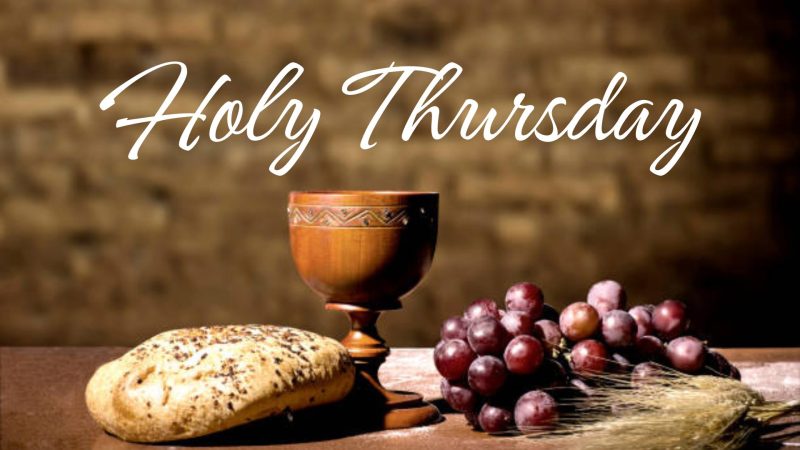
The Eucharist is not just bread and wine on an altar. It is a life poured out. It is a love that kneels before others, saying, “Let me serve you.”
“Do this in remembrance of me,” he says.
We often limit our hearing to the bread broken, the cup shared. Tonight, though, we are reminded that remembrance is deeper than ritual. To “do this” means to take on Jesus’s posture, to love without counting the cost, to kneel rather than stand above.
And then Jesus says something that should stop us in our tracks: “I have set you an example, that you also should do as I have done to you.” Not admire it. Not theologize it. Not simply remember it. But do it.
This is where Holy Thursday becomes deeply personal. It’s one thing to receive the Eucharist. It is another thing entirely to become what we receive.
We come to the altar, stretch out our hands, receive the Body of Christ, and are sent out as the Body of Christ, a body that serves, loves, and kneels.
Jesus continues, “Just as I have loved you, you also should love one another.” Not as we feel like it, not when convenient or safe, but as he has loved us.
And how has he loved us? With a towel and a basin. With bread and a cup. With a cross already looming in the distance.
Holy Thursday holds these things together: the table and the towel. Sacrament and service. The gift we receive and the life we are called to live. We cannot separate them.
Eucharist alone becomes an empty ritual; service alone becomes an unsustainable effort. Only together do they form the heart of Christian life.
Tonight, we are invited not just to remember, but to enter this mystery. Come to the table, not because we are worthy, but because we are loved. Receive what we cannot earn. Be fed by grace.
And then, rise from the table, take the towel, and consciously seek ways, this week and always, to serve those around you. Go intentionally into the world to show this kind of love.
Holy Thursday teaches that the world needs love shown in action. Love that serves. Love that kneels. Love that endures. Love to the very end.
As we move from this night into the darkness of Good Friday, let us not forget what we have seen here. Let us remember: the One who knelt before his friends. The One who fed them. The One who loved them to the end.
Let us each ask, honestly and prayerfully: Where am I called, right now, to kneel as a servant? Who in my life is waiting for my service? How, concretely, can I show this kind of love today and in the days to come?
This is Christ’s commandment. This is the gift and the call of the Eucharist. This is the way of love we are asked to embody, love that transforms, love that breaks us open and sends us out, love that changes the world.
So let us go forth, changed, called, and sent, to love as Christ has loved us. Amen.