
Well, here we are. Another Sunday and another hastily rewritten sermon because of a catastrophic world event. I cannot count the number of times I have had to rewrite sermons based on changes in the world but, here we are. Bombs are dropping, human beings are dying, and, some people are rejoicing.
It appears a man who perpetrated evil on an immense scale has been killed. However, as followers of the Prince of Peace, we cannot rejoice in the death of another human. Rather, let us say, “May his name and memory be blotted out.”
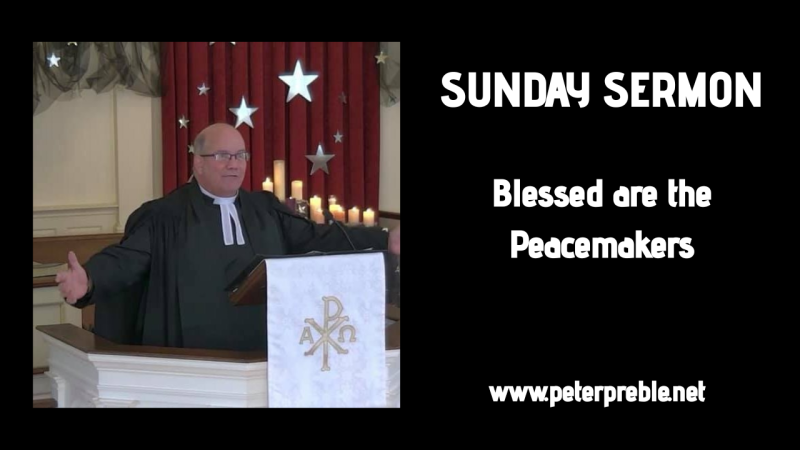
But let us not forget the words from Jesus we heard this morning from the Gospel of Matthew, “Blessed are the peacemakers, for they shall be called children of God.”
Those words are short. Simple. Almost gentle.
But do not mistake their gentleness for weakness.
In these deeply troubling days, as violence escalates in this new war involving Iran and others in the region, Jesus’ words land with sharp urgency. They are not abstract spirituality. They are not poetic sentiment. They are a summons.
“Blessed are the peacemakers.”
Not blessed are the powerful.
Not blessed are the warmongers.
Not blessed are the victorious.
Not blessed are those who dominate the battlefield.
Blessed are the peacemakers.
When Jesus speaks these words in the Sermon on the Mount, he is not addressing emperors or generals. He is speaking to ordinary people living under Roman occupation. People who knew military presence in their streets. People who understood that decisions made in distant halls of power could disrupt, wound, or even end their lives.
They knew what it meant to live beneath empire. And to them, to people without armies, without influence in imperial courts, Jesus says: you are blessed when you make peace. That alone should unsettle us.
Because in our world, blessing is often equated with strength, leverage, dominance, and victory. But Jesus redefines blessing as he does with so many thngs. He locates it not in conquest, but in reconciliation.
We must be clear: peacemaking is not passive. It is not pretending that injustice does not exist. It is not moral equivalence. It is not naïve optimism.
Peacemaking is active. It is courageous. It is costly. It is easier to escalate than to de-escalate. It is easier to retaliate than to restrain. It is easier to wrap violence in patriotic or ideological language than to do the patient, frustrating, fragile work of diplomacy.
War promises clarity. It promises resolution through force. It promises strength.
History teaches us otherwise.
War spreads. It destabilizes. It wounds generations. The cost is borne not only by leaders and governments, but by families, by children, by the vulnerable, by those whose names we will never know but whose lives are precious to God.
The Rev. Karen Georgia Thompson, General Minister and President of the United Church of Christ, spoke words that name this moral reality with clarity: “We call for an end to the abuse of government might that is poured out on people who are not the ones making decisions yet bear the brunt of the ensuing violence, casualties of actions they do not support.”
That is not partisan speech. That is prophetic truth.
Too often, those who suffer most are not those who decide. Civilians become casualties. Infrastructure collapses. Children inherit trauma. Entire communities are destabilized by forces far beyond their control.
And the Gospel insists that those lives matter.
And what happens next? What is our responsibility as the ones who caused the destabilization of another country? What is our obligation to the people we say we just freed from a mad man? What will the cost be in human lives, in tax dollars, in moral certainty? Dropping the bombs is the easy part, cleaning up the mess created by those bombs is hard and costly.
When Jesus calls peacemakers blessed, he is not offering a political slogan. He is revealing the character of God.
Children resemble their parents. To be called children of God is to reflect God’s heart. And the heart of God is not bent toward destruction, but toward reconciliation.
Throughout Scripture, we encounter a God who hears the cry of the oppressed. A God who sends prophets to interrupt violence. A God who calls nations to account. A God who declares that swords shall be beaten into plowshares.
And in Jesus Christ, we see that heart embodied. We follow the One who told Peter to put away the sword. We follow the One who wept over Jerusalem’s coming violence. We follow the One who forgave even from the cross.
If we claim his name, we cannot treat peacemaking as optional.
Now, let us be honest: this is not simple.
There are real threats in our world. There are dangerous regimes. There are injustices that must be confronted. Peacemaking does not mean ignoring evil. It does not mean abandoning accountability. It does not mean leaving the vulnerable unprotected.
But neither does it mean baptizing every escalation as righteousness.
Peacemaking asks deeper questions.
What will actually protect the innocent? What will actually preserve life? What will interrupt the cycle rather than intensify it?
And perhaps most importantly: who bears the cost?
If the cost is poured out upon people who are not making decisions, if it falls upon families, upon children, upon the elderly, upon those simply trying to live, then we must ask whether we are reflecting the heart of God.
Jesus does not say, “Blessed are those who win.” He says, “Blessed are the peacemakers.”
The Greek word suggests those who actively create peace, who forge it, who build it, who labor for it. Peace is not merely the absence of war. It is the presence of justice, dignity, and right relationship.
Shalom. Wholeness. Flourishing.
That kind of peace requires imagination, the imagination to believe enemies can become neighbors, that diplomacy is not weakness, that restraint can be strength. It requires humility, the humility to admit that no nation is ultimate. No ideology is sovereign. No military is redemptive.
Only God is sovereign.
But here is the harder truth.
Peacemaking does not begin in foreign policy. It begins in the human heart.
Jesus’ Sermon on the Mount moves from interior transformation to outward action. Anger, contempt, lust for domination, these are seeds. The seeds of violence are planted long before armies mobilize.
They are planted in narratives of fear. In language that strips others of humanity. In the slow erosion of empathy.
Are we cultivating peace in our own lives? Or are we nurturing resentment? Are we quick to demonize entire peoples? Quick to assume the worst? Quick to reduce complex human beings into caricatures?
The Church must resist that erosion.
We must insist that every life, Iranian, Israeli, American, Palestinian, every life is held within the love of God. We must insist that no child is expendable, and that includes those sexually abused by the privileged class. We must insist that no bomb carries righteousness within it.
The Sanskrit word “Namaste” is often translated as the phrase, “the spirit in me recognizes the spirit in you.” This is a profound translation as it signifies that a shared divine light, or soul exists within all individuals, transcending physical differences to foster mutual respect, equality, and connection.
As a follower of Jesus, commanded to love everyone including our enemies, we must see that divine light in the other person and we must foster mutual respect, equality, and connection.
And we must pray, not as an afterthought, not to avoid engagement, but as a discipline that shapes our hearts toward compassion rather than vengeance.
To pray for peace is to allow God to rearrange our instincts. To be peacemakers is to live in tension. It is to refuse simplistic binaries. It is to acknowledge complexity without surrendering to cynicism.
It is to speak when silence would be easier.
It may cost us. It may cost us popularity. It may cost us comfort. It may cost us the ease of aligning uncritically with national narratives. But Jesus never promised that blessing and ease were the same thing. He promised that those who resemble the heart of God would be called God’s children.
“Blessed are the peacemakers.”
Blessed are those who defend the innocent who bear the brunt of decisions they did not make. Blessed are those who advocate restraint when the drums of war grow loud. Blessed are those who insist that diplomacy is not weakness but wisdom. Blessed are those who believe that love is stronger than fear.
They shall be called children of God. Not because they fix every geopolitical crisis. Not because they eliminate conflict overnight. But because in their lives, the family resemblance becomes visible.
The Church may not control governments. But we shape consciences. We form hearts. We proclaim another way. And in times like these, that witness matters profoundly.
So, what does peacemaking look like for us?
It looks like praying for leaders, that they will pursue de-escalation and dialogue with courage equal to the courage required for war. It looks like refusing dehumanizing rhetoric. It looks like educating ourselves beyond slogans. It looks like supporting humanitarian efforts that care for those caught in conflict. It looks like forming our children not in hatred, but in empathy.
It looks like examining our own hearts and asking ourselves questions. Where am I harboring contempt and for whom? Where have I grown numb to suffering because it feels distant? Where have I confused strength with aggression?
Peacemaking begins there. And then it radiates outward.
In a world trembling under the weight of violence, perhaps the most radical act of faith is to believe that peace is still possible. Not inevitable. But possible.
Because the resurrection tells us that violence does not have the final word. Because the cross reveals that love is willing to absorb hatred rather than perpetuate it. Because the Spirit continues to work in hearts and in history.
“Blessed are the peacemakers, for they shall be called children of God.”
May we live so that the name fits. May our words reflect mercy. May our advocacy reflect justice. May our prayers reflect courage.
And may our lives, in ways large and small, bear witness to the God whose deepest desire is not destruction — but reconciliation.
Amen.