
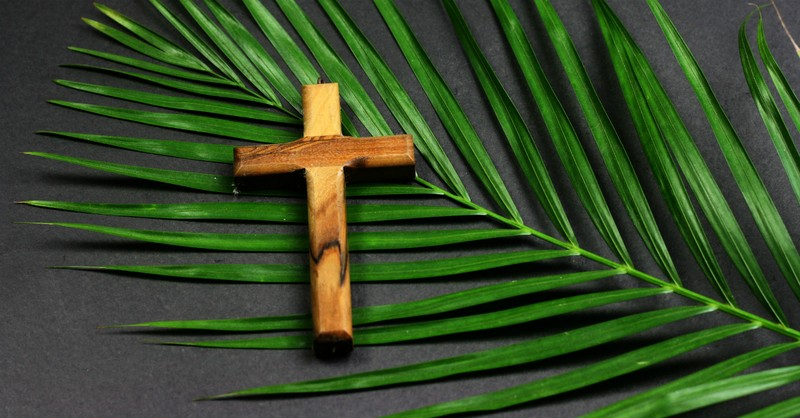
There is something deeply unsettling about Palm Sunday, if we are willing to sit with it long enough.
It begins with real joy, overflowing into the streets—jackets thrown down, branches waving, voices raised: “Hosanna to the Son of David! Blessed is the one who comes in the name of the Lord!”
It feels like a parade. It feels like a protest rally. It feels like a victory march. It feels like everything is finally going right.
And this is the part we love—the celebratory, public, confident faith. The triumph lingers, and we want to linger there too.
But the Church, in her wisdom, or perhaps in her refusal to let us hide from the truth, does not allow us to stay there. Because almost as soon as the palms are raised, the tone shifts. The liturgy changes. The story turns. And we find ourselves no longer in a parade, but in a Passion.
The same voices that cried out “Hosanna” will soon cry out “Crucify him.” And that shift is not just something that happened long ago. It is not just about them. It is about us.
Matthew tells us that when Jesus enters Jerusalem, the whole city is in turmoil. It was Passover and the city was full of people. The word he uses suggests something like an earthquake, a shaking, a disturbance. People are asking, “Who is this?”
And the answer comes: “This is the prophet Jesus from Nazareth in Galilee.”
It is a good answer. A respectful answer. Even a faithful answer. But it is not the whole truth. They see a prophet. They welcome a king. But they do not yet understand a Savior who suffers.
And if we are honest, neither do we.
We want a certain kind of Messiah. We want a Jesus who fixes things. A Jesus who does it all, so we don’t have to. A Jesus who restores order. A Jesus who validates our expectations and affirms our sense of how the world should work. A Jesus who hates the same people we do. We want a king who rides in strength, who conquers, who wins.
But Jesus comes on a donkey. Not by accident. Not because there were no other options. But intentionally, deliberately, prophetically. He is fulfilling the words of the prophet: “Look, your king is coming to you, humble, and mounted on a donkey.”
When the conquerors entered the city they had just conquered, they would ride on a big horse. When a King or a general wanted peace with a city, they would come riding on a donkey, a beast of burden, a beast of humility and peace.
This is not a king who comes in power as the world understands power. This is not a king who comes to dominate. This is not a king who puts his name on buildings. This is not a king who puts his face on gold coins. This is not a king who puts his signature on dollar bills. This is a king who comes in humility.
And that should give us pause. Because humility is not what we usually look for in leadership. It is not what we usually celebrate. It is not what we instinctively trust. We are taught that humility and compassion are weaknesses. We are told that empathy is a sin. And yet, this is how God chooses to enter the city.
But even more than that, Jesus knows exactly where this road leads. He knows the cheers will fade. He knows the crowd will turn. He knows the cross is waiting. And still, he goes. With a smile on his face.
There is something profoundly important in that. This is not a story that spins out of control. This is not a tragedy that catches Jesus by surprise. Jesus is deliberately provoking the authorities with this act. This is a deliberate act of love.
He enters Jerusalem not because things are going well, but because they are about to go terribly wrong, and he refuses to turn away. And then, as we move from the procession into the Passion, Matthew draws us into the story in a way that is almost uncomfortable.
Because we begin to recognize the characters. Judas betrays, but not out of pure malice. Perhaps out of disappointment. Perhaps out of disillusionment. Perhaps because Jesus was not the Messiah he expected.
Peter denies, but not because he does not love Jesus. He does. Deeply. But fear gets the better of him. The disciples scatter, not because they are faithless, but because they are human. And the crowd… the crowd shifts. That is perhaps the hardest part. Because crowds still shift. Public opinion still turns. What is celebrated one moment is condemned the next.
And if we are honest, we know this is not just about ancient Jerusalem. We have all had moments where we have been Judas, choosing something else over Christ. Moments where we have been Peter, failing to stand firm when it mattered most. Moments where we have been part of the crowd, swept along, uncertain, inconsistent.
Palm Sunday forces us to confront that reality. It holds up a mirror and asks, “Where am I in this story?”
But here is where the story refuses to become merely a story about human failure. Because even as all of this unfolds, even as betrayal, denial, abandonment, and injustice take center stage, Jesus remains steadfast.
In the Garden of Gethsemane, we see the most human moment of all. Jesus prays: “My Father, if it is possible, let this cup pass from me.” There is no denial of suffering here. No pretending that this is easy. No spiritual bypassing. Jesus names the pain. He feels the weight of what is coming. He tries to get out of it. He tries to bargain with God.
And then he says: “it’s not what I want Father, but what you want.” That is not resignation. That is trust. Deep, costly, vulnerable trust.
Before Pilate, Jesus stands silent. He does not defend himself with clever arguments or by shouting ‘fake news’. He does not make fun of Pilate and call him crass names. He does not call upon power to save himself. He does not even seem interested in winning, as we understand it.
Because the victory he is seeking is not about avoiding the cross. It is about transforming what the cross represents. It is about turning the symbol of hate into a message of love.
And then we come to the crucifixion itself. A place of shame. A place of humiliation. A place of suffering and death. And this is where our theology is tested. Because we often want to ask: Why does God allow suffering? And that is not a small question. It is not an abstract question. It is a question born out of real pain, real loss, real grief. Experiences we have all had.
Palm Sunday, as we move into the Passion, does not give us a neat or tidy answer. Instead, it gives us something far more challenging and far more profound. It shows us a God who does not stand at a distance from suffering. It shows us a God who enters into it. Fully. Completely. Without holding back.
A God who knows betrayal from the inside. A God who knows what it is to be misunderstood. A God who knows what it is to be abandoned by friends. A God who knows physical pain, emotional anguish, and even the experience of death.
This is not a distant deity. This is Emmanuel, God with us. Even here. Especially here.
And so the question shifts. Not why does God allow suffering? But where is God in the midst of suffering?
And the answer, given to us in the Passion, is this: God is right there. On the cross. In the pain. In the darkness. In the place we would least expect, and often where we least want to look.
And yet, even here, even at the cross, the story is not without hope. Because woven through the Passion are these small, quiet signs that something more is happening. The curtain of the temple will be torn in two. The earth will shake. The centurion will confess: “Truly this man was God’s Son.”
Even in death, something is being revealed. Even in suffering, something is being transformed. And that something is unconditional love for everyone, even those who have put the nails in his hands and feet. Even the ones who betrayed and denied him. And even the ones who ran away and hid.
Palm Sunday invites us to live in the tension that holds together the joy of the procession and the sorrow of the Passion. To resist the temptation to rush too quickly to Easter, while also refusing to believe that Good Friday and the crucifixion are the end of the story.
Because we know, though we do not yet fully celebrate it, that resurrection is coming. Not as an escape from suffering, but as a transformation of it. Not as a denial of death, but as a defeat of it.
So, what does this mean for us? It means that to follow Jesus is not simply to wave palms when it is easy. It is to walk the road when it is hard. It’s to love when love costs something. It’s to forgive when forgiveness feels impossible. It’s to remain present in the face of suffering, our own and that of others. It’s, ultimately, to take up our cross.
And that is not a metaphor we should rush past. Because crosses are heavy. They are real. They are often unwelcome. But they are also the place where transformation happens.
Palm Sunday asks us: What kind of disciples do we want to be? Disciples of convenience? Or disciples of commitment? Followers of a triumphant moment? Or followers of a crucified and risen Lord?
Because the truth is, we cannot have Easter without Good Friday. We cannot have resurrection without the cross. We cannot fully understand the depth of God’s love unless we are willing to walk through the places where that love is most costly.
And yet, here is the grace. We do not walk this road alone. The same Christ who enters Jerusalem walks with us. The same Christ who prays in the garden prays for us. The same Christ who endures the cross meets us in our suffering. And the same Christ who is raised will raise us, too.
So today, as we hold our palms, let us do so with open hearts and open eyes. Let us celebrate, but not superficially. Let us reflect, but not despair. Let us commit ourselves again to following Jesus, not just in the moments of joy, but in the moments of challenge, of uncertainty, and even of suffering.
Because this is the road to which we are called. A road that leads through Jerusalem. Through the garden. Through the cross. And, by the grace of God, to the empty tomb.
Amen.