
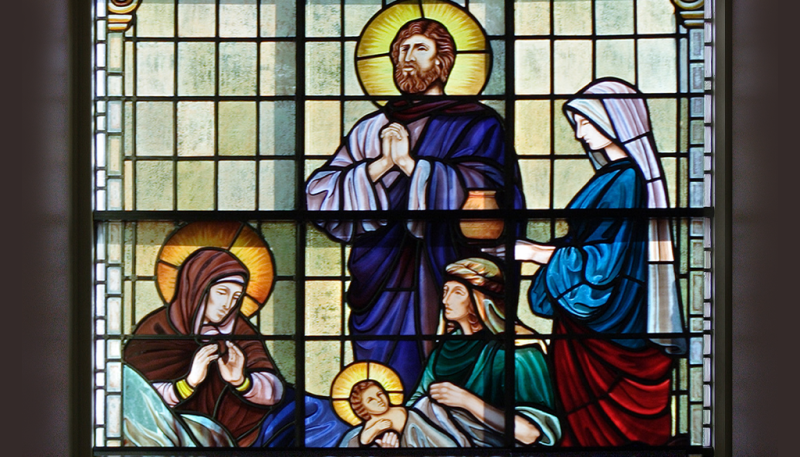
December 8th is the Feast of the Immaculate Conception. This feat celebrates the belief that Mary, from the moment of her conception, was preserved from the stain of original sin. It is a feast with deep theological roots, rich devotional practices, and a long history of reflection. But it is also a feast that Protestants, by and large, do not observe. There are many reasons for hesitation around the celebration of this feast, biblical, historical, and theological, but one of the central reasons lies in the Reformed understanding of sin itself, especially the rejection of the doctrine of original sin as it applies to Mary.
This difference is not simply a matter of piety or preference; it reflects deeper theological commitments that trace back to the Reformation and continue to shape a theological identity today.
To understand why this belief varies, we must understand Roman Catholic doctrine. Defined formally in 1854 but rooted in medieval theology, the Immaculate Conception teaches that “Mary was conceived without original sin so that she could serve as a fitting, uncontaminated ‘vessel’ for the Incarnation.” This sinlessness is not seen as anything Mary accomplished on her own but as a special application of Christ’s future redemption, granted to her when she was conceived.
Reformed Theology does not affirm this doctrine. But the reason is not because of a disregard for Mary, far from it. Reformed Theology holds Mary in high esteem as the mother of Jesus, the “highly favored one,” the courageous disciple who said yes to God. The disagreement is for another reason: in the Protestant understanding of sin, particularly the rejection of the Roman Catholic understanding of original sin as something passed biologically or genealogically from one generation to the next.
In Roman Catholic theology, original sin is a kind of inherited condition, something transmitted from parent to child, something that attaches to the human person at conception. Because of this understanding, the Immaculate Conception becomes necessary. If sin is transmitted like a spiritual gene, then Christ’s humanity must be protected from this inheritance. Mary, therefore, must be purified in advance.
But the Reformers did not see original sin this way. Luther, Calvin, and the generations that followed understood original sin not primarily as a biological transmission but as the universal human condition of alienation from God. Sin, in Reformed thought, is not a metaphysical stain passed down through the bloodstream. It is a relational brokenness, a condition that affects all of us because we are part of the same fallen story, not because we physically inherit guilt.
For Protestants, original sin does not require an immaculate Mary for her son to be sinless. Jesus’ sinlessness does not depend on the purity of Mary’s conception; it depends on the mystery of the Incarnation itself. Jesus is sinless because he is both fully human and fully divine, the “Word made flesh,” the one who takes on humanity without taking on its rebellion. His holiness is inherent, not dependent.
This difference is subtle but profound. For the Reformers, to protect Jesus’ sinlessness through Mary’s sinlessness is to take a theological journey Scripture never lays out. It shifts the focus from the Incarnation as God’s decisive act to a chain of biological purity that must be protected. Reformed theology trusts the Incarnation itself, God becoming flesh, as sufficient. Jesus is holy because God is holy, not because Mary was specially exempted from the human condition.
A second Reformed concern arises from Scripture. Nowhere is Mary’s sinlessness taught, much less her immaculate conception. In fact, Mary herself sings, “My spirit rejoices in God my Savior,” a line Protestants have long taken as evidence that Mary understood herself to need God’s grace like everyone else. She is blessed, chosen, and filled with grace, but not differently from the rest of us.
The Reformed rejection of the Immaculate Conception is ultimately a reaffirmation of a basic understanding that all humans, Mary included, stand equally in need of God’s grace. The beauty of Mary’s story lies not in her exemption from the fallen nature of humanity but in her participation in it. She is one of us, ordinary, vulnerable, historically conditioned, and yet God chooses her to bear Christ into the world. This is the very heart of the gospel: God works through ordinary people, not because we are perfect, but because grace finds us.
There is also a pastoral dimension to this perspective. If Mary must be sinless for Christ to be born, what does that say about the rest of us? If God only works through the immaculate, what hope is there for ordinary people who carry the burdens and complexities of authentic human life? The Reformed understanding holds up Mary not as an exception but as a model, a person who experienced God’s call in the midst of her humanity, not apart from it.
The rejection of the Immaculate Conception is not a rejection of Mary. The Reformed understanding portrays Mary as someone whose faithfulness was worked out amid her human frailty. Her courage becomes more, not less, remarkable when we see her as an ordinary young woman graced by God.
Although Protestants will not celebrate the Feast of the Immaculate Conception, the day still invites a reflection on sin not as an inherited stain but as a universal human story; on grace not as exception but as gift; and on Mary, not because she was set apart from the human condition, but because she shows us how God enters into our human condition with love, humility, and transforming presence.