
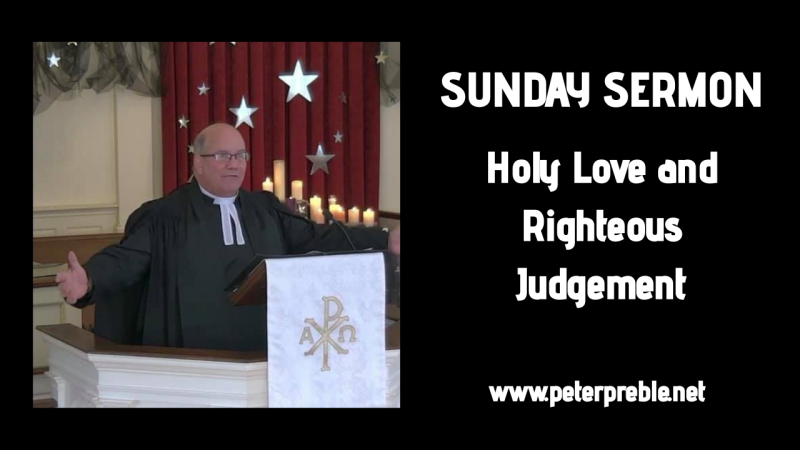
This morning, we finish the section about God. These lines from the United Church of Christ Statement of Faith are said so often that they risk becoming familiar without being fully heard. We are invited to linger with these words:
“He seeks in holy love to save all people from aimlessness and sin.
He judged men and nations by his righteous will declared through prophets and apostles.”
These lines may sound like they are pulling us in two different directions. Holy love sounds welcoming, gentle, and reassuring. Judgment makes many of us uncomfortable. And sin, well, that word carries a great deal of baggage. But the Statement of Faith does not shy away from holding these realities together, because Scripture itself refuses to separate love from truth, or grace from moral seriousness.
The Statement of Faith refuses to let us separate what God has joined together. Love without truth becomes sentimentality. Judgment without love becomes cruelty. The faith we proclaim insists that God’s love is strong enough to tell the truth, and God’s judgment is rooted in a desire to heal rather than to harm.
My theological position is not to speak of sin as inherited guilt or human worthlessness. I don’t believe that people are born condemned, broken beyond repair, or separated from God by some ancient biological failure. I believe we need to acknowledge something far more recognizable and honest: that to be human is to be finite, fragile, and vulnerable to distortion.
We are not born sinful in the sense of being morally corrupt from birth. But we are born into a world already bent out of shape, into histories of injustice, systems of inequality, patterns of fear and violence that predate us and shape us long before we are aware of them. We arrive not guilty, but conditioned. Not damned but disoriented.
Theologian Paul Tillich named this condition estrangement. Sin, he said, is separation, from God, from others, from us, not a moral defect passed down through biology, but an existential condition that arises from freedom and fear.
In this light, sin is real, but it is not the denial of human worth. It is the distortion of human freedom. We are not sinners because we are human; we sin because we are human and afraid.
God’s response is not rejection but seeking love.
“He seeks in holy love to save all people from aimlessness and sin.”
Aimlessness is a profoundly pastoral word. It acknowledges something deeply human: the experience of drifting, of losing our center, of waking up one day unsure how we got where we are or what our lives are oriented towards.
Before sin becomes willful wrongdoing, it is often a loss of direction. It is forgetting who we are, whose we are, and what we are for. Scripture names this: sheep without a shepherd, people wandering, hearts that have lost their way.
Long before sin becomes deliberate wrongdoing, it is often disorientation. Augustine understood this well. He described sin not first as lawbreaking, but as disordered love. In his Confessions, Augustine wrote that the human heart is restless until it rests in God, not because humans are evil by nature, but because we so easily love the wrong things in the wrong order. Aimlessness, in this sense, is loving lesser things as though they were ultimate.
God’s holy love addresses that condition first. God seeks not to condemn, but to reorient. To save us from aimlessness is to call us back to purpose, to restore our capacity to live in right relationship with God, neighbor, and the world.
But love does not stop at reassurance. Love also tells the truth. And so, the Statement continues: “He judged men and nations by his righteous will declared through prophets and apostles.” Here is where we need to pay close attention to the scope of that judgment. Not just individuals. Not just private morality. Men and nations.
God’s judgment is not about tallying personal failures or policing moral purity. It is about naming where human freedom has gone wrong, where fear has overtaken trust, where self-interest has eclipsed responsibility, where systems we benefit from harming others.
The prophets were relentless on this point. They did not accuse people of being born sinful; they accused nations of becoming unjust. They did not judge humanity’s existence, but humanity’s choices. They named economic exploitation, political violence, religious hypocrisy, and indifference to suffering as violations of God’s righteousness.
Ezekiel 16:49, “Now this was the sin of your sister Sodom: She and her daughters were arrogant, overfed and unconcerned; they did not help the poor and needy.”
Baptist theologian and Pastor Walter Rauschenbusch would later say that the doctrine of sin is the religious interpretation of a universal social fact. Sin is not only personal; it is structural. It is embedded in systems that reward greed, excuse violence, and render suffering invisible. And God’s judgment is not directed at human existence itself, but at the ways we organize our common life.
This is where many of us become uncomfortable. We are often willing to accept a God who forgives individual shortcomings. We are less comfortable with a God who judges nations, who asks hard questions about policies, priorities, and power.
Scripture insists that God’s righteousness is not confined to private virtue. The apostles carried this witness forward. Mary’s song announces a God who brings down the powerful and lifts the lowly. Jesus speaks more harshly to those who benefit from unjust systems than to those who struggle within them. The poor are not the problem; the system that keeps them poor is. And those who benefit are.
In this view, sin is not so much a stain as it is an estrangement. We are estranged from God when we forget our dependence. We are estranged from one another when we allow difference to become hierarchy. And we are estranged from ourselves when fear shapes our lives more than love.
And God’s judgment, declared through prophets and apostles, is not meant to crush us, but to awaken us. Judgment is clarity. It is the moment when the truth breaks through our justifications and calls us back to what is real and life-giving.
Judgment, then, is not about punishment. It is about truth. It is what happens when God’s holy love refuses to lie about the cost of our choices.
Reinhold Niebuhr captured this tension beautifully when he said that humans are both capable of justice and inclined toward injustice. That is why love must be joined to accountability. Without judgment, love becomes naïve. Without love, judgment becomes destructive.
And here is the crucial point: the God who judges is the same God who seeks to save. Judgment is not the final word; it is a necessary word along the way. God exposes brokenness not to shame us, but to heal us. God names injustice not to condemn humanity, but to call us back to responsibility.
Friends, this is a faith that takes humanity seriously, our freedom, our responsibility, and our capacity for change. It refuses to despair about human nature, even as it refuses to deny human failure. It trusts that grace is stronger than estrangement, and that love is more powerful than fear.
We are not saved from being human. We are saved into our humanity, called to live awake, purposeful, and accountable in a world God refuses to abandon.
May we hear God’s judgment not as a threat, but as an invitation. May we receive God’s love not as permission to remain unchanged, but as courage to live differently.
For the One who seeks us in holy love is still calling people and nations toward righteousness, justice, and life.
Amen.