
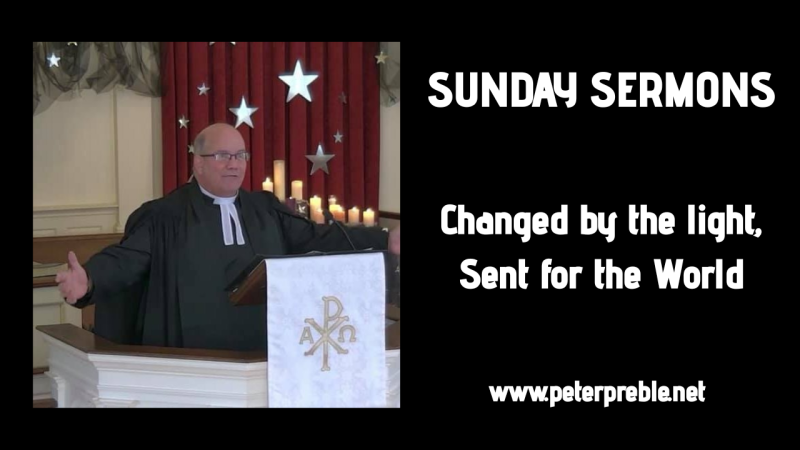
Several weeks ago, we began a study of the United Church of Christ’s Statement of Faith. This study has taken us through a discussion about God the creator, God the Son, and God the Holy Spirit. We touched briefly on the Sacraments of Baptism and Communion. We learned about the nature and mission of the Church, and today, we bring it all to a close with a promise and a call.
I know I have learned a lot from preparing these teachings and the subsequent discussions we had after Church, but there is so much more to learn. The two things I want us to take away from this are that the statement is not a creed, it is not an all-or-nothing proposition. The statement is just that, a statement of not just what we believe but what we have faith in.
The second takeaway is that without action, these words mean nothing. Today is the last Sunday of the Epiphany season, and on Wednesday, we begin the journey of Lent. Today, the Church focuses on the story of the Transfiguration. We begin with Moses, coming down from his mountain-top experience after hearing God’s voice. Exodus tells us his appearance had changed, but that was not all.
We heard from Matthew about Jesus’ trip up the mountain with Peter, James, and John, and how he changed in appearance. Encounters with the Divine are supposed to transform us not just on the outside but deep inside, in the very core of our being, in our soul.
About a year after my ordination, I began writing a blog online. The tagline I began with was to “form, inform, and transform.” For me, the entire spiritual life is about transformation, about coming into the presence of the Divine, not just on that mountain top but down here, in the valleys of life in the food pantry, soup kitchen, and protest. I checked this morning, and I have written 3, 532 essays about the spiritual life, some good, most well, not so good. But there they are.
Today, we come to the last part of our study of the Statement, the final words which are both promise and call, covenant and action.
“He promises to all who trust him forgiveness of sins and fullness of grace, courage in the struggle for justice and peace, his presence in trial and rejoicing, and eternal life in his kingdom which has no end.”
These sentences do more than inform; they form us, and I hope, they transform us. These words, if we dare to take them seriously, will rearrange how we live. These are not sentimental religious words. They are revolutionary claims. They are sacramental claims. They are promises that reach into the core of our lives and into the structures of our common life.
These last words of the Statement begin where the Gospel always begins: with mercy.
“He promises… forgiveness of sins and fullness of grace.”
This is a reminder that in a world that keeps score, God does not. In a culture that brands people by their worst mistake, God does not. In a society that monetizes shame and weaponizes failure, Christ speaks of forgiveness.
But forgiveness is not divine amnesia. It is divine restoration. It is God’s refusal to let our brokenness have the final word. Forgiveness is not pretending sin does not matter; it is declaring that grace matters more.
And grace is not thin sentimentality. Grace is the power of God to remake a human heart.
When we trust Jesus, we are not merely excused. We are reclaimed. We are told that beneath our fear, beneath our selfishness, beneath our complicity in unjust systems, there remains the indelible image of God.
Grace does not simply comfort us. Grace calls us higher because forgiven people cannot remain unchanged.
If we have received mercy, we must become merciful. If we have been restored, we must become agents of restoration. If we have been freed from shame, we must refuse to shame others—forgiveness births responsibility.
But we cannot stop at personal redemption. It moves immediately outward:
“He promises… courage in the struggle for justice and peace.”
Struggle. Not comfort. Not passivity. Not spiritual escape. Struggle.
Justice and peace do not descend gently from the heavens. They are struggling for. They require courage. And here is the truth we do not always want to name: courage is necessary because injustice is real.
Some systems crush. Some policies wound. There are habits of indifference that allow suffering to continue unchallenged. The Gospel does not deny this reality. It confronts it.
But we do not enter that struggle alone or empty-handed. We enter it forgiven. We enter it graced. We enter it sustained by Christ.
The courage promised here is not boasting. It is not anger masquerading as righteousness. It is the quiet, steady resolve that comes from knowing that we belong to something larger than any empire and to a love stronger than any fear.
Justice, in our tradition, is not partisan. It is biblical. It is sacramental. If every human being bears the image of God, then every system that denies that dignity must be challenged.
Peace is not the absence of conflict. It is the presence of the right relationship. And a right relationship requires repair.
To trust Jesus is to be given courage, courage to speak, courage to stand, courage to persist, courage to love even when love costs something. And boy, does love cost.
But we must go deeper; we are being called into relationship with the world and with one another, and we will not be left alone.
“He promises… his presence in trial and rejoicing.”
Notice what is not promised. We are not promised immunity from suffering. We are not promised ease. We are not promised that faith will shield us from loss. Jesus says, ” If the world hates you, remember, they hated me first.”
We are promised presence. Not an easy life. And that changes everything.
Because a trial will come, illness will come. Grief will come. Doubt will come. There will be seasons when prayer feels thin, and God feels silent. There will be days when the struggle for justice feels overwhelming, and the work seems endless.
But Jesus promises presence, and that should bring us comfort. This is not a distant observation. Not detached sympathy. But presence.
The Incarnation, the Word becoming flesh and dwelling with us, is proof of this promise. God does not remain far from human pain. God entered it. Walks within it. Suffers it. Transforms it from within.
And rejoicing, too, is holy ground. Celebration is not frivolous. Joy is not naïve. Rejoicing is a foretaste of the kingdom. When we gather in love, when we celebrate milestones, when we sing with full hearts, Jesus is present there as well.
Our faith is not only cross; it is resurrection. Not only lament, it is song.
Jesus meets us in hospital rooms and at wedding receptions. In gravesides and in baptisms. In protest marches and at kitchen tables.
Presence is the promise that holds us steady.
As you know, I work as a hospice chaplain, and for the last few months, I have had the privilege of working at our hospice house. This residence can accommodate 12 people on their final journey. We offer them comfort, companionship, and dignity in their final days.
This week, I have had the honor of accompanying three people and their families as they have taken their last breaths. Some were religious, most were not. In every room, I felt God’s presence. It’s hard to describe what that is, but I felt it, and it made the journey that much sweeter. Presence is important.
Then the Statement opens our vision and broadens our horizon:
“He promises… eternal life in his kingdom which has no end.”
Eternal life is not merely longevity. It is participation in the life of God. It is communion that death cannot sever.
The kingdom without end is not an escape from this world; it is the fulfillment of God’s intention for this world. We are called not to wait for God’s kingdom but to bring God’s kingdom right here, right now.
A kingdom where justice rolls down like waters. A kingdom where peace is not fragile. A kingdom where no child is hungry. A kingdom where swords are beaten into plowshares. A kingdom where love is the final architecture of reality.
That kingdom begins now. Here. Not on some distant cloud but right here, outside those doors and inside.
Every act of forgiveness participates in it. Every step toward justice reflects it. Every courageous stand anticipates it. Every moment of presence embodies it.
We do not build the kingdom by our own strength. But we witness it. We align ourselves with it. We live as though it is already breaking into our world, because in Jesus, it is.
The words from the Statement of Faith today begin with trust: “He promises to all who trust him…”
Trust is not intellectual assent alone. It is entrusting our lives to Christ’s way.
It is trusting forgiveness enough to let go of bitterness. It is trusting grace enough to risk transformation. It is trusting courage enough to enter the struggle. It is trusting presence enough to endure trial. It is trusting eternal life enough to resist despair.
Trust reshapes priorities. It reorders allegiances. It redefines success.
If Jesus’ promises are true, and I believe they are, then fear does not get to rule us. Cynicism does not get to define us. Despair does not get to silence us.
We are a forgiven people. We are a courageous people. We are an accompanied people. We are a hopeful people.
Beloved, these are not merely words to recite. They are promises to inhabit.
The world does not need a Church fluent in religious language. The world needs a Church formed by these promises.
The world needs a Church that forgives boldly. Struggles for justice steadily. Remains present in suffering faithfully. And a Church that lives in hope defiantly. The world needs a Church less concerned about self-preservation and more about action.
This is not easy discipleship. But it is faithful discipleship.
Jesus has promised. And because Jesus has promised, we can live differently. We can love differently. We can struggle differently. We can hope differently.
For we belong to a kingdom that has no end.
“He has shown you, O mortal, what is good. And what does the Lord require of you? To act justly and to love mercy and to walk humbly with your God.
Amen.