
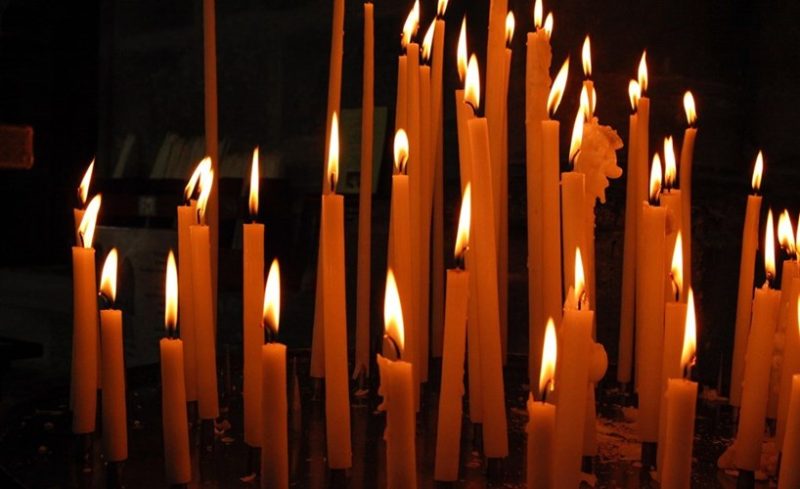
A few weeks ago, our lights went out because of a downed powerline. Our town has a generator system that is supposed to bring the power back while repairs are being made but they had difficulty getting those generators started. It was a bit of an inconvenience while the sun was but, as the sun began to set, darkness started to cover the house, and it started to get cold.
We are not used to not having light when darkness comes. We flip a switch, and the light returns. As darkness started to take over, we scrambled to find candles and flashlights that would provide the basic light needed for safety. Light in the darkness was becoming a necessity.
As our country plunges deeper and deeper into moral darkness, shining light is becoming very important. People filming law enforcement, standing shoulder to shoulder with neighbors to protect them, marching in the streets, painting protest signs all bring light. People gathered quietly on town commons and street corners holding candles in silent vigil after another of our neighbors was murdered by armed agents of our government bring the flickering light to our national conscious.
It is into that darkness that Candlemas arrives quietly on the church calendar. Forty days after Christmas the Church pauses to bless light. We gather candles, speak ancient words, and remember a moment so ordinary it might have been overlooked: a young family bringing their child to the Temple, fulfilling the law, offering what little they had. Yet the Church insists that here glory appears.
Mary and Joseph bring Jesus to Jerusalem, offering “a pair of turtledoves or two young pigeons” (Luke 2:24), the sacrifice of the poor. There is no spectacle. Instead, there is recognition. The old man Simeon takes the child into his arms and names him “a light for revelation to the Gentiles and for glory to your people Israel” (Luke 2:32). Anna, an elder and a prophet, adds her voice. Redemption is glimpsed not through power, but through faithfulness.
The Church calls this day Candlemas because it dares to say what Simeon sees: light. Not the blinding glare of empire or triumph, but the fragile flame of promise. Divine light does not hover above the world untouched; it is placed into human hands, it stands on street corners and city parks, entrusted to bodies, bound to history. The Divine light takes on human form and stands in solidarity with the vulnerable among us.
But this idea of light did not begin with Candlemas or even with the birth of Jesus. These days of midwinter is where Candlemas quietly meets the ancient rhythms of the earth.
Long before this feast had a Christian name, early February was marked across the northern world as a threshold season. Imbolc, an ancient Celtic festival, celebrated the returning light, the quickening of the land, the first signs that winter’s grip would not last forever. It was a time of lambing, of milk returning to the fields, of hope held gently rather than declared boldly. Darkness was not denied; it was simply no longer final.
Christian faith did not erase these rhythms, it embraced them, it baptized them.
In the liberal catholic imagination, this is not syncretism but sacramentality. God has always spoken through seasons, through land and body, through longing and labor. Candlemas does not compete with Imbolc; it fulfills its deepest intuition. The light we bless is not abstract salvation, but embodied hope, hope that grows slowly, quietly, and at cost.
Nowhere is this convergence more beautifully held than in the figure of St. Brigid.
Brigid of Kildare, whose feast is celebrated on February 1, stands at the meeting place of ancient reverence and Christian witness. Whether she is understood her as a Christian saint who inherited the symbolism of an earlier goddess, or as a singular figure whose life gathered many streams, Brigid embodies what the Church often forgets: holiness rooted in hospitality, justice, and care for the earth.
Brigid is remembered as a woman of fire and generosity, a protector of the poor, a healer, a poet, and a keeper of sacred flame. At Kildare, her community tended to a perpetual fire, a sign not of domination, but of vigilance and nurture. This is Candlemas theology. Light is not seized; it is tended. It is kept alive through attention, humility, and shared responsibility.
Simeon’s song is often heard as triumphal, but it is not naïve. He names the cost: “This child is destined for the falling and rising of many… and a sword will pierce your own soul too” he says to Mary (Luke 2:34–35). Candlemas light does not deny suffering; it illuminates it. As St. Brigid’s work reminds us, light expressed through compassion exposes injustice. Fire warms, but it also reveals.
This is why Candlemas stands as a hinge in the liturgical year. Christmas joy gives way to vocational resolve. The shadow of the cross already stretches across the church floor. Faith here is not sentiment, but courage. As Rowan Williams has written, Christian hope is not escape from suffering, but trust that suffering does not have the final word.
The blessing of candles, then, is not decorative. It is formative. When we lift light and ask God’s blessing, we are asking to become bearers of that light in a world still shaped by fear, violence, and scarcity. Like Brigid, we are called to tend what is fragile, to shelter what is vulnerable, to believe that generosity is stronger than hoarding.
Candlemas is also a feast of elders and edges. Simeon and Anna remind us that revelation belongs not only to the young or the powerful, but to those who have waited long enough to recognize it. Imbolc, too, honors thresholds, neither winter nor spring, neither death nor full bloom. This is faith lived between certainty and fulfillment.
In blessing candles, we bless time itself, past promises fulfilled, present faith sustained, future hope entrusted. Candlemas teaches us to notice God not only in beginnings, but in transitions; not only in birth, but in dedication; not only in joy, but in resolve.
The light of Candlemas does not banish the dark. It teaches us how to walk within it, patiently, faithfully, together. A small flame. A steady hand. And the quiet assurance that God’s light, once given, will not be taken back.