![]()
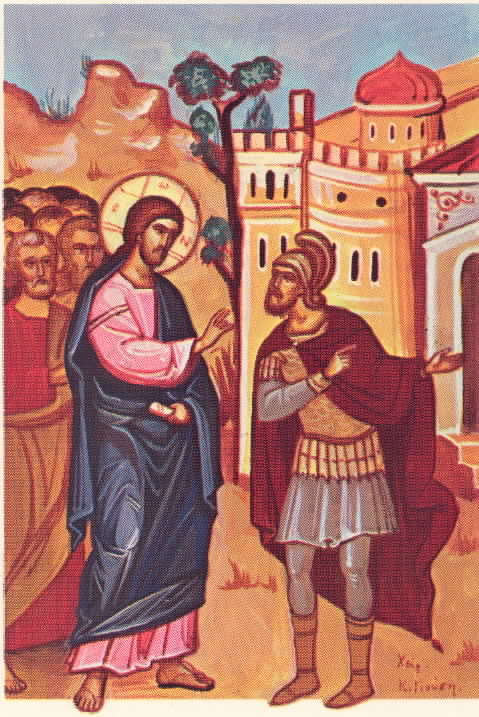
At that time, as Jesus entered Capernaum, a centurion came forward to him, beseeching him and saying, “Lord, my servant is lying paralyzed at home, in terrible distress.” And he said to him, “I will come and heal him.” But the centurion answered him, “Lord, I am not worthy to have you come under my roof; but only say the word, and my servant will be healed. For I am a man under authority, with soldiers under me; and I say to one, ‘Go,’ and he goes, and to another, ‘Come,’ and he comes, and to my slave, ‘Do this,’ and he does it.” When Jesus heard him, he marveled, and said to those who followed him, “Truly, I say to you, not even in Israel have I found such faith. I tell you, many will come from east and west and sit at table with Abraham, Isaac, and Jacob in the kingdom of heaven, while the sons of the kingdom will be thrown into the outer darkness; there men will weep and gnash their teeth.” And to the centurion Jesus said, “Go; be it done for you as you have believed.” And the servant was healed at that very moment. (Matthew 8:5-13)
In this week’s Gospel passage we have another healing of Jesus but this one is a little different than the ones that come before and perhaps the ones that come after.
In the passage just before this, Matthew 8:1-4, Jesus heals a leper by touching him. This would have made Jesus ritually unclean and that is something that is unacceptable to someone who practices the Jewish faith. Lepers were sent away from the city for two reasons, one if they came into contact with someone that person, like Jesus in the story, would have become unclean and two, leprosy was, and is, highly contagious! Jesus reached out and touched the man and healed him.
In today’s Gospel we see a Roman Centurion come to Jesus and ask Him to heal his servant.
A Roman Centurion is a commander of more than 100 Roman troops, this is not a man who begs very easily for anything but we see him begging Jesus to heal his servant. Notice that the Centurion calls Jesus “Lord” another thing that a Roman Soldier, of any rank, would do. It is quite possible by the way that the Centurions servant is himself a Jew!
We now have a declaration by the Centurion that has become part of our Liturgical Services, “Lord, I am not worthy that You should come under my roof. But only speak a word, and my servant will be healed.” This is a reminder to us that none of us are worthy to have Jesus, our Lord and Savior, come under our roof. We are all of us, sinners and have fallen short of the Glory of God, but with one word, one action of Jesus, the Crucifixion, Jesus has put us on the road to worthiness. The faith of this man to recognize the fact that he, and we, are not worthy is a reminder to us all.
For the second time in the Gospel we see that Jesus was marveled. The first time was at the recognition of the unbelief of the people of His own hometown, and the second is here in this story. Jesus marveled at this man’s faith! The Lord and Savior of us all was marveled by this man’s faith. Here we see another example of the humanness of Jesus, the one who created all of us and knew us before we had a name, was marveled at this man’s faith. But there was something else going on here.
Jesus makes the pronouncement, “I have not found such great faith, not even in Israel.” He says that, “Many will come from East and West” but the, “Sons of the Kingdom of Heaven will be cast out into utter darkness.” He is speaking here not only of the Jews that refused to recognize Him as the Messiah but also those of us who do not “live” our faith!
I have told you before that it is not enough for us to come and follow all the rules and regulations of the Church we have to live our faith everyday out in the world. Mother Maria of Paris, a saint I have grown very close too over the last year, has this to say about our life as Christians:
“At the Last Judgment I will not be asked whether I satisfactorily practiced asceticism, nor how many prostrations and bows I have made before the holy table. I will be asked whether I fed the hungry, clothed the naked, visited the sick and the prisoner in jail. That is all I will be asked.”
Our lives as Christians should be not about ourselves, but about another! If we do not “live” our faith, Jesus tells us we will be cast into outer darkness!
This past week, I have been attacked in the local and statewide media for living our Christian faith. There were some pretty dark days this past week and I took great solace in two passages of Scripture that I think we would do well to commit to memory:
“If the world hates you, you know that it hated me before it hated you. If you were of the world, the world would love its own. Yet because you are not of the world, but I chose you out of the world, therefore the world hates you.” John 15:18-19
Jesus tells us that the world will hate us, and trust me when I say this too you, the world does hate us! The world hates us when we feed the hungry, clothe the naked, visit the sick and those in prison. But we do not have a choice to do these things or not because Jesus commands us to do this. But we are in good company as Jesus tells us to remember that the world hated Him first! We are a chosen race, a royal priesthood. We are a resurrection people and Alleluia is our Song!
“Blessed are you when people insult you, persecute you and falsely say all kinds of evil against you because of me. Rejoice and be glad, because great is your reward in heaven, for in the same way they persecuted the prophets who were before you.” Matthew 5:11-12
This passage is part of the Sermon on the Mount or the Beatitudes and we sing this each time we celebrate the Divine Liturgy just before the Little Entrance. These words that I have heard hundreds of times have taken a new and very personal meaning for me. It is easy to be Christian when things are going well; the challenge comes to hang in there when the times are difficult. “Great is your reward in Heaven.” Well at least I have that going for me!
These are not easy words for us to hear and even worse when it is actually happening to us. I felt as though I was all alone. Looking back I can imagine this is how Jesus felt the night before His crucifixion when he went to pray and asked his Apostles to wait, and they fell asleep. Or when he was arrested and his closest friends left Him and one sold him, and the other denied Him!
Then a good friend emailed me both of these quotes and somehow I knew it was all going to be okay.
Jesus is calling each of us to step out of our comfort zone and live the kind of life that He is asking us to live. This is not an easy life. It was not easy for the Centurion in today’s Gospel to come forward and ask Jesus for help but he did it because he had such great faith that he knew that Jesus would grant his request.
We are being asked to live an extraordinary life for Jesus. To live for someone other than ourselves. To place our life in His hands and trust in Him that all will be okay. This is a lesson I learned this past week and one that I hope I will remember for a long time to come.
Are you willing, today, to take that step that is necessary to live your faith and not just practice it?