
Matthew 2:13–15, 19–23
We do not often hear this part of the story, but Matthew tells a part of the Christmas story that rarely appears on greeting cards.
In today’s passage from Matthew, there are no angels singing here. No shepherds. No serene manger scenes. Everyone has gone home, and Mary, Joseph, and their son are left alone.
At a time when there should be happiness, there is fear. There is violence. There is flight.
After the Magi leave, Matthew tells us that an angel appears to Joseph in a dream and says, “Get up. Take the child and his mother and flee to Egypt and remain there until I tell you.” And Joseph does exactly that. Joseph trusts this angel, who has never steered him wrong.
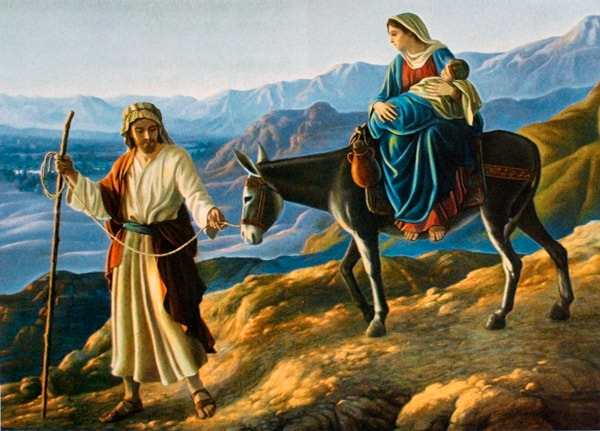
Joseph wakes from his dream, and he gets up in the middle of the night. He gathers Mary, the child, and everything and anything they can carry, and they become refugees. Out into the cold night. Out into the cruel world.
We hear that phrase-“they fled in the night”-and it can sound almost poetic.
But we know what that really looks like. It looks like parents packing only what they can carry. It looks like children who don’t understand why they can’t go back home. It looks like phones held up to catch one last signal before crossing a border.
We have seen it on the news. Families leaving Ukraine with a single suitcase. Parents walking through deserts at our southern border. Children sleeping in detention centers, wrapped in foil blankets that crinkle every time they move.
And if we’re honest, we don’t usually imagine Jesus in those images.
But Matthew insists that we do. Because the Holy Family does not flee from the human story. They flee inside it. This is how the story continues.
We are sometimes tempted to sanitize the gospel stories, to make them safe, tidy, and reassuring. We do not like to dwell on the bits of scripture that we do not like. But Matthew refuses to do that. Matthew draws us in and forces us to face reality.
Matthew insists that, from the very beginning, Jesus’ life is shaped not only by wonder but also by threat. The Christmas story did not end with the manger; it began there and continues from there.
Herod is afraid. He does not know what all of this means, he does not know what is happening, and he does not like how this makes him feel. And when powerful people are afraid, children suffer.
Herod is not just a historical figure. Herod is any system that chooses control over compassion. Any leader who trades truth for fear. Any policy that sacrifices the vulnerable to protect power. Herod is alive whenever children are harmed to preserve adult certainty.
Matthew reminds us that the gospel is not neutral in the face of that kind of fear. God does not bless it. God escapes it.
So, God does something astonishing. God runs.
God does not send armies. God does not overthrow Herod. God does not protect the child with force. God does not pass legislation to force people to do what he wants. God entrusts the future of salvation to a frightened family crossing a border.
That alone should stop us in our tracks.
Matthew is not subtle when he tells us that the family flees to Egypt. Egypt is not just a place on a map. Egypt is memory. Egypt is trauma. Egypt is the place from which Israel once fled. And now, God’s own Son flees to Egypt.
Matthew quotes the prophet Hosea: “Out of Egypt I have called my son.” This is not prediction. It is interpretation.
By quoting Hosea, Matthew is saying that God is doing something familiar yet completely new. Liberation is being rewritten, not as a single dramatic escape, but as a long, uncertain survival.
My theology insists that incarnation matters. The Word becoming flesh is not just a nice story; it really matters. Jesus does not float above history. He was born into it. He is part of it.
That means Jesus knows displacement, not as metaphor, but as lived reality. He knows what it is to leave home in fear. He knows what it is to depend on the kindness of strangers. He knows what it is to be marked as “other” in a foreign land.
And here’s the uncomfortable truth: If Jesus were born today, many Christians would argue about whether he belongs here.
If Jesus were born today, the debate would not be theological first; unfortunately, it would be political.
People would ask, Do they have papers? Are they documented? Did they cross legally? Who is paying for this? I guess all of these are legitimate political questions, but the God who requires us to love everyone, feed the hungry, clothe the naked, and welcome the stranger would tell us to take care of the people first, then ask the questions.
Because standing right in front of us, in the middle of all the political noise, a frightened family would still just be trying to survive.
This story forces us to ask a hard question, not about immigration policy, but about discipleship. Can we recognize Christ when he arrives with dust on his shoes and fear in his eyes?
This story does not allow us to spiritualize away the real suffering of real people. God’s salvation story runs directly through the lives of the vulnerable.
And then, quietly, the story moves on. Herod dies.
History often moves like that. The powerful die, but the damage remains.
The Angel returns, and Joseph dreams again. Another instruction is given. Another journey is about to begin. It is now safe, and they can return, but not to where they started.
Joseph plans to return to Judea, but he is afraid; he is afraid for his wife and his young son. And again, fear is not dismissed. Fear is honored. So, the family settles in Nazareth. Nazareth, small, unimpressive, overlooked.
Nothing in the prophets says clearly, “He will be called a Nazarene.” Matthew stretches here, the way preachers sometimes do, because he is trying to say something deeper.
Jesus grows up on the margins, poor, struggling, and afraid. He is not in Jerusalem or near the seat of power. He learns faith in a small-town synagogue, not in the religious center, not in the Temple. God’s presence chooses obscurity over power and prestige.
What does all this mean for us? What lesson is Matthew trying to teach with this story of fear and uncertainty?
In this text, Matthew is not teaching about geography alone, but about what kind of God we worship. We worship a God who chooses vulnerability over dominance. A God who enters history through risk. A God who trusts human courage more than divine force.
My theology refuses to turn this story into abstract doctrine. It asks what this story reveals about God’s priorities. And the answer is clear.
God’s concern is not first for control, but for life. Not for certainty, but for faithfulness. Not for power, but for presence.
But friends, the lesson does not end there, for this story also reminds us that revelation does not stop at the safe verses. God speaks in dreams. God speaks through fear. God speaks through movement and change. And sometimes, God speaks by saying, “Do not stay where you are.”
The Holy Family survives not by standing their ground, but by moving when the moment demands it. That is a word the church still needs to hear.
The story not only reminds us that God is still speaking, but also that God is still moving.
Faithfulness does not always look like staying put. Sometimes it looks like leaving what is familiar. Sometimes it looks like choosing the safer road rather than the braver-sounding one. Sometimes it looks like trusting that God is present even when the path is unclear.
Joseph never speaks in this story. But his faith is loud. He listens. He moves. He protects life.
Epiphany is about revelation. And here is the revelation Matthew shows us that God is found not in Herod’s palace, but on the road to Egypt. Not in certainty, but in trust. Not in dominance, but in care.
Jesus is revealed not as a conquering king, but as a child who survives because others choose compassion over fear.
So, the question this story leaves us with is not simply, do we believe this happened?
The question is: Would we recognize the Holy Family if they showed up here? Not dressed in holiness. Not speaking our language. Not fitting our expectations. Would we see them, or would we ask them to move along?
Matthew doesn’t answer that question for us. He leaves it with the church.
Amen.