
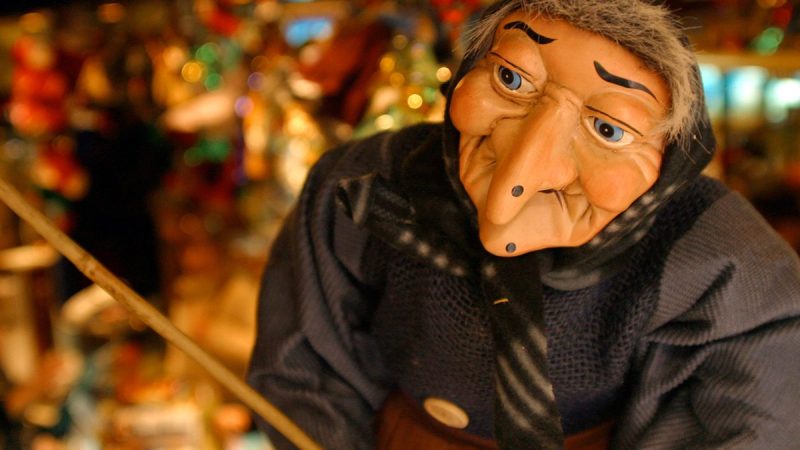
There is a legend of a witch that dates to Pagan times and is an integral part of Italian folklore. The legend of La Befana draws together Pagan and Christian theology in celebration of the Epiphany that speaks to us today with her sacred wisdom.
The origin of the name Befana comes from the Greek word Epiphaneia, meaning “manifestation” or “appearance,” and refers to the visit of the Magi to Mary, Joseph, and Jesus. Over centuries, Epifania became Befania, then Befana in popular speech.
In Roman and pre-Roman times, figures resembling La Befana have appeared in agricultural traditions. La Befana is linked to ancient fertility goddesses and earth mothers who represent the earth’s cycles.
In Roman Times, La Befana made appearances at festivals around the solstice and would be included in rituals honoring the spirits, ensuring the fertility of the coming year. La Befana, often depicted as an old woman, would fly through the night symbolizing the passing of the old year.
As Christianity began to spread, La Befana became part of the Epiphany story. While journeying to see the Christ Child, the Magi stopped at the home of La Befana, where she offered them food and shelter but declined to join them.
She later regretted her decision not to join the Magi, and so she gathered gifts she could bring to the Child and set off, flying through the night in search of the Magi and the Child. Unable to find the child, La Befana gave the gifts to the children she did find in the hopes that one of them might be Jesus.
Today, the legend has it that La Befana visits children on the night of January 5th, leaving candy and presents for the good children and coal for the, well, not-so-good. She is depicted as an old woman flying on a broom, part grandmother, part witch, and part holy pilgrim. There are major celebrations in Rome that combine religious observance with folk festivals.
There is a tremendous amount of symbolic meaning in La Befana. The legend combines the folk with the theological, the Pagan with the Christian, in such a way that shows how traditions can come together to tell a story. La Befana shows the wisdom of age rather than youthful beauty. La Befana points towards the truth that one is never too old to seek the things that are holy. And most importantly, La Befana shows that we do not have to be perfect; she is flawed, human, and still beloved.
And there is a deep, theological symbolism to La Befana as she reminds us that those on the margins carry sacred wisdom, a reminder that God’s revelation is not just for the rich and powerful but for everyone, and La Befana reminds us to continue to search even after missing opportunities.
La Befana is not merely an Italian “Christmas witch,” but a rich symbol of memory, repentance, generosity, hospitality, hope, and second chances standing at the crossroads of ancient ritual and Christian faith.
Let us Pray:
Holy God of wandering stars and open doors, you met the Magi on the road and you meet us in moments we almost miss.
We remember the one who stayed behind, who hesitated, who later went searching, carrying gifts, hope, and regret in her hands.
Forgive us when we delay love, when fear or comfort keeps us from the journey. Bless our second chances, our late beginnings, our imperfect faith.
Teach us to recognize Christ in every child we meet, in every stranger we welcome, in every door we dare to open.
As La Befana shared her gifts along the way, may we give freely, not only from certainty, but from longing and compassion.
Sweep away what no longer gives life. Make room for wonder. Lead us by your light, even when the road is long and the hour is late.
For it is never too late to seek the Holy One. Amen.