
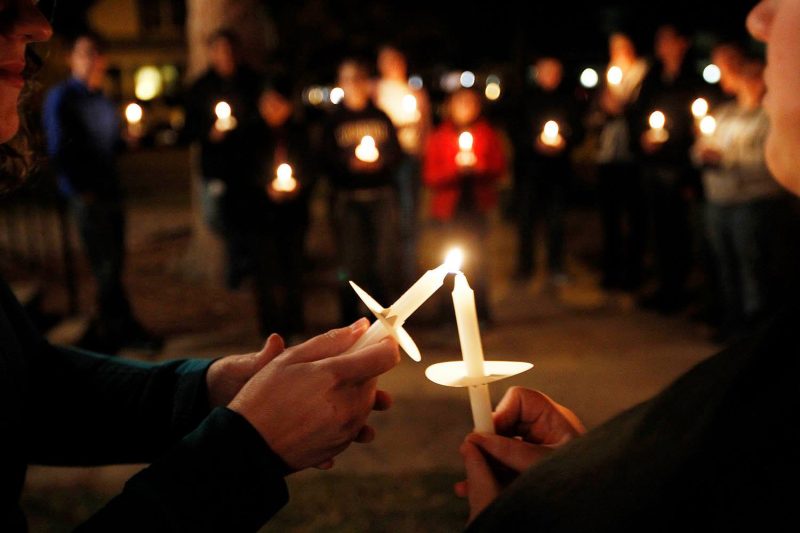
A few years after my ordination, I traveled to Washington, DC, to attend the March for Life. This annual event in DC arose in response to the Supreme Court’s Roe v. Wade ruling. Marchers, who do not consider themselves protesters, arrive from across the country, many staying in churches overnight.
After gathering the night before, the day begins with a Mass at the National Shrine. From there, participants walk together to the Supreme Court, where several Roman Catholic and Orthodox Bishops speak to the assembly about the evils of abortion and the ongoing fight to overturn what they see as a stain on the American soul.
At that time, I was a young (ish) priest, uncertain of my theological position on many social issues. Serving in the Romanian Orthodox Church, which had no defined social gospel and did not think it needed one, I sought a sense of belonging. In retrospect, my opposition to abortion and other social issues seemed to follow an easier, more accepted path, rather than a firmly discerned conviction.
Following the crowd is one of the easiest things to do. Taking a stand, even an unpopular one, is difficult, but that is what we are called to do.
Contemporary religious discourse has reduced the term pro-life ” to a single moral claim: opposition to abortion grounded in the assertion that life begins at conception. While concern for unborn life deserves moral seriousness, this reduction represents a profound narrowing of Christian ethical vision. Such single-issue moralism stands in tension with Scripture, theological anthropology, and the Gospel’s expansive understanding of life.
Christian faith does not call us to protect only biological origins. It calls us to honor life as relational (existing in connection with others), social (formed in community), historical (shaped over time), and moral (involving right and wrong actions)—a reality sustained not only by birth but also by justice, compassion, and community.
There is no single biblical doctrine that declares that life begins at conception. Life is presented as something animated by divine breath and sustained in relationships. In the Book of Genesis, humanity becomes alive when God breathes life into the body: “Then the Lord God formed the human from the dust of the ground and breathed into his nostrils the breath of life; and the human became a living being.” (Genesis 2:7) Life here is ruach, spirit, and breath, not merely a biological process.
Ezekiel’s dry bones remain lifeless until God’s Spirit enters them. (Ezekiel 37:14) The risen Christ breathes on the disciples, imparting life and vocation. (John 20:22) Biblically, life is not reducible to cellular existence; it is dynamic, God-given, and sustained within community.
Texts frequently cited to support conception-based definitions of life, such as Psalm 139 or Jeremiah 1:5, are poetic affirmations of divine knowledge and care, not biological claims. Liberal biblical scholarship has long recognized these passages as confessions of trust in God’s providence rather than metaphysical assertions about fetal personhood. (Walter Brueggemann, Theology of the Old Testament)
The Liberal theological position understands that life is a process of becoming, not a static moment fixed in time. Friedrich Schleiermacher grounded human worth not in biological status but in consciousness of absolute dependence upon God. (The Christian Faith) From this perspective, life unfolds relationally, morally, and spiritually rather than beginning as a fully formed moral subject at conception.
Paul Tillich defined life as participation in “being-itself,” insisting that ethical judgments must attend to actual existence, power, and vulnerability, rather than to abstract biological thresholds. (Systematic Theology, Vol. 3) Tillich warned that moral absolutism detached from lived reality becomes demonic, elevating partial truths into total claims. (The Courage to Be)
Richard Niebuhr taught that Christian ethics must pay attention to history and relationships. Moral responsibility arises from discernment in real relationships. Ethical concern for pregnancy must include women’s agency, social context, and shared responsibility, not just embryology. (The Responsible Self)
Christian ethics does not speculate about the biological beginnings of life, but about the life and teaching of Jesus. Jesus defines life not by origin but by abundance: “I came that they may have life and have it abundantly.” (John 10:10) Abundant life requires nourishment, healing, dignity, and liberation from oppressive systems.
The judgment scene of Matthew 25 offers no concern for ideological purity or metaphysical certainty. Instead, Matthew presents the teaching of Jesus as embodied care for the hungry, the sick, the imprisoned, and the stranger. Life is affirmed where human beings are sustained in dignity, and it is denied where neglect, violence, or indifference prevail.
Dietrich Bonhoeffer insisted that ethical faithfulness must be lived “in the penultimate,” amid ambiguity and risk. (Ethics) Bonhoeffer rejected moral systems that insulated believers from responsibility through rigid rules. For Bonhoeffer, Christian ethics demanded courageous discernment in the face of complex human realities, a stance deeply at odds with simplistic pro-life frameworks that ignore social consequence.
Reduction of the pro-life identity to being simply anti-abortion allows Christians to claim moral certainty while at the same time supporting systems that destroy life in other forms. Reinhold Niebuhr warned precisely against such moral self-righteousness, noting that the greatest ethical danger lies in confusing partial moral insight with divine righteousness. (Moral Man and Immoral Society)
A theology that defends embryonic life while tolerating child poverty, racialized violence, inadequate healthcare, environmental degradation, mass incarceration, or war reveals not moral consistency but moral fragmentation. The prophet Amos’ rebuke is loud on this point: “I hate, I despise your festivals… but let justice roll down like waters.” (Amos 5:21, 24) Justice, not a selective moral position, is the biblical measure of fidelity.
James Cone, writing from the Black liberation tradition, exposed the deadly consequences of moral abstraction separated from lived suffering. Cone insisted that any Christian ethic that fails to confront systemic injustice is not merely incomplete but complicit in that injustice. (A Black Theology of Liberation) From this point, a pro-life ethic that ignores racialized death, state violence, and economic abandonment cannot claim allegiance to the God of life.
From a Liberal Catholic perspective, to say that life does not simply begin at conception is not to deny moral value to prenatal life. It is to affirm that life is relational, developmental, and morally complex. Ethical seriousness increases as relational capacity, vulnerability, and relationships increase.
Such a position demands more, not less, moral responsibility. It calls for robust support for women, children, families, and communities; for healthcare, education, and economic justice; for peacemaking and environmental stewardship. Life is diminished wherever human beings are treated as expendable, whether in the womb, at the border, in prison, or in neglected neighborhoods.
A Christian ethic of life must be larger than a single issue and humbler than absolute claims. It must be rooted in Scripture read historically, theology formed by experience, and conscience shaped in community. To be pro-life, in any meaningful Christian sense, is to be pro-justice, pro-compassion, and pro-human flourishing.
As the Apostle Paul reminds us, “The letter kills, but the Spirit gives life.” (2 Corinthians 3:6) A theology animated by the Spirit will always resist reductionism, attend to suffering, and insist that life is sacred not only because it begins, but because it is sustained, shared, and redeemed.