Archpastoral Letter of His Beatitude, Metropolitan Jonah Pascha 2011

CHRIST IS RISEN! INDEED HE IS RISEN!
To the Very Reverend and Reverend Clergy, Monastics, and Faithful of The Orthodox Church in America
Dearly Beloved in the Lord: Christ is Risen!
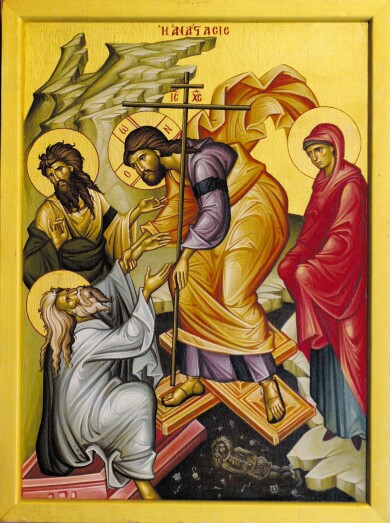
“This is the day that the Lord has made.” Today, our Lord is risen from the dead, releasing each of us from our sins and, ultimately, death itself. It marks the beginning of a new life filled with the radiance of Christ’s resurrection. “Let us rejoice and be glad in it!”
This newness of life has the power to transform us. The efforts and struggles we faced on our journey through Great Lent have prepared us for Christ’s victory over death. Our prayers, fasting, and almsgiving were not ends unto themselves; rather, they were the tools that allowed us to empty ourselves of our passions and receive Christ into our hearts. As the Apostle Paul wrote to the Galatians, “it is no longer I who live, but Christ lives in me; and the life which I now live in the flesh I live by faith in the Son of God, who loved me and gave Himself for me” [Galatians 2:20].
As our Paschal Lamb, Jesus Christ sacrificed Himself so that each of us may live a new life filled with joy, faith, and love. By His resurrection from the dead — and our resurrection in Him — we have become partakers of His divine nature. He has become our daily bread, nourishing us and giving us the strength to live as Christians in today’s world. Let us cast off the shackles of our former lives, and be clothed in the robe of light, illumined by the light of Christ’s resurrection. Let us open our minds and hearts to the light that beams forth from the empty tomb.
Our Lord has given us an example of love so beautiful, so wonderful, and so powerful that it must be the foundation of everything we do in our lives. The love of God has destroyed the power of death and overcome the devil. What a magnificent blessing! The love of God the Father, revealed in Christ’s obedience unto death, has wiped the slate clean, and we are given a new beginning. What an amazing treasure! The sacrifice of Jesus Christ on the Cross has conquered death. We are set free. What a divine gift!
The Paschal joy that we feel today cannot and must not end with the dismissal of today’s Liturgy or our agape meal — and certainly not with the return to our “daily routines.” When we allow Christ’s joy and love to permeate every facet of our lives, the light of Christ’s resurrection will continue in our hearts long after our Paschal candles have been extinguished.
My dear brothers and sisters in Christ! Let us give glory to the One Who rose from the dead! And let us, as members of the Body of Christ, partake in His love, and share it with everyone around us!
Christ is risen! Indeed, He is risen!
With love in the risen Christ,
+ JONAH
Archbishop of Washington
Metropolitan of All America and Canada

One Word at a Time ~ Adventure

It has been a few months since I last participated in the “One Word at a Time Blog Carnival” and it is nice to be back with these few words on Adventure.
It is interesting that this is the word that comes during the (celebration is not the right word) commemoration of Holy Week. Jesus has asked us to follow Him on His adventure as he heads towards the Cross to die, not for anything He did, but to die for what we have and will do. That’s right, Jesus died for you!
Holy Week in the Orthodox Church is an adventure. If one is to come to all of the services, that is an adventure in itself, one will follow Jesus as He takes His last steps. The services of Holy Week transform us into eyewitnesses and direct participants in the awesome events of the Passion and Resurrection of Jesus Christ.
We start the week on Sunday evening with the telling of the coming sufferings by Jesus to His closest friends, those friends by the way that will abandon Him when He needs them the most. We are told next to be ever watchful and prepared for we do not know the day or the hour that our end will come. We read the parable of the Ten Virgins as a reminder to always have oil for our lamps.
We are instructed to move from a life of sin to a life of true repentance as we witness the sinful woman washing Jesus feet with her tears and drying them with her hair. The middle of the week comes the Unction or healing service. All of us need to be healed both in body and soul and we are reminded of this during this service. We are reminded of relationships that need healing as well as the things that make us ill no matter what those things are. We cannot witness the Resurrection if we are ill so healing is important. The Church gives us the Sacrament of Anointing for this purpose. We are reminded that it is the life of prayer that mends the relationship with God and with others. We are also reconciled to God and one another so that they might receive the gift of the Holy Eucharist instituted by Christ at the Last Supper.
Thursday evening we follow Jesus through the Gospel as he takes is final step son the Via Dolorosa. The Cross on which will hang Him who spread out the clouds is carried in procession and with the lights dimmed the Corpus is hung on the cross. The sound of the pounding of the nails will ring through the Church as a reminded of our sins that pierce the flesh of our Savior as He willingly submits to His own death.
Friday we remove the Corpus and have the funeral service for Jesus, the service ends with a solemn procession around the Church and we sing the Lamentations as a reminder of all the He has done and will do for us His children.
Then comes the real start of the adventure, the Resurrection service. The night begins in complete darkness reminiscent of the world that is full of darkness as we, the faithful, await the resurrection. The lone light is brought forth from the Holy Place and each person takes the light back to his or her place. We are reminded that Christ brings the light into the world but it is up to us to carry that light as a witness of Him to all the corners of the world. The Church slowly comes to life as the light moves through, we read the Resurrection Gospel and sing, “Christ is Risen” for the first time and enter the Church that is no ablaze with light as Christ has Truly risen and is ever present in His Church and with His people.
The Adventure does not come to an end but only comes to a beginning. We begin a new year in Christ as we take Him from the Holy Place out into the world to show that Christ has indeed destroyed death by death and that we are all called to a life with him.
Come and enjoy this adventure with us and with Jesus!

Patriarchal Encyclical on Pascha 2011

Prot. No. 404
Beloved children in the Lord,
Once again, in a spirit of joy and peace, we address you with the delightful and hopeful greeting: “Christ is Risen!”
The occurrences and events of our time may not seem to justify the exultation of our greeting. The natural destruction caused by seismic tremors and oceanic swells, together with the lurking devastation from possible nuclear explosion, as well as the human sacrifices resulting from military conflict and terrorist action, reveal our world to be in horrible torment and anguish from the pressure of the natural and spiritual forces of evil.
Nevertheless, the Resurrection of Christ is indeed real and grants to faithful Christians the certainty – and to all humanity the possibility – of transcending the adverse consequences of natural calamity and spiritual perversity.
Nature rebels when the arrogant human mind endeavors to tame its boundless forces endowed by the Creator to its seemingly insignificant and inactive elements. In considering from a spiritual perspective the grievous natural phenomena that plague our planet repeatedly and successively in recent times, we appreciate and acknowledge the belief that these are inseparable from the spiritual and ethical deviation of humanity. The signs of this deviation – such as greed, avarice, and an insatiable desire for material wealth, alongside an indifference toward the poverty endured by so many as a result of the imbalanced affluence of the few – may not be clearly related to the natural occurrences in the eyes of scientists. Yet, for someone examining the matter spiritually, sin disturbs the harmony of spiritual and natural relations alike. For, there is a mystical connection between moral and natural evil; if we wish to be liberated from the latter, we must reject the former.
Our Risen Lord Jesus Christ, the new Adam and God, constitutes the model for the beneficial influence of a saint on the natural world. For Christ healed physical and spiritual illness, granting comfort and healing to all people, while at the same time bringing calm and peace to stormy seas, multiplying five loaves of bread to feed the five thousand, thereby combining the reconciliation of spiritual and natural harmony. If we want to exert a positive impact on the current negative natural and political conditions of our world, then we have no other alternative than faith in the Risen Christ and fulfillment of his saving commandments.
Christ has risen and given new life to the perfect ethos of humankind, which had darkened this ethos. Christ became the first-born and pioneer of the regeneration of the world and the whole of creation. The message of the Resurrection is not empty of meaning for the quality of human life and the balanced function of nature. As we completely and profoundly experience the Resurrection of Christ in the depth of our heart, our existence shall favorably impact upon all humanity and the natural world. The natural sciences may not yet fully have underlined the relationship between the regeneration of humanity and the renewal of creation, but the experience of the saints – which should be the aim of our own experience – confirms the experientially proven fact that, indeed, a person reborn in Christ restores the harmony of the natural world disturbed by sin. In Christ, the saint can move mountains for the good of the world, while the sinful person, who opposes the ways of God, can shake the earth and raise destructive waves.
Let us approach the sanctity of the Risen Christ in order, through His grace, to calm the natural and moral waves that trouble our world today.
May the grace of our Risen Lord Jesus Christ be with you all, beloved children in the Lord. Amen.
Holy Pascha 2011
+Bartholomew of Constantinople
Fervent supplicant for all
before the Risen Christ

Palm Sunday Sermon

Our Lenten journey has come to an end. I hope these days have been different than the rest of the year. Each Lent we have an awesome opportunity to enhance our spiritual life and to grow in our faith. My only hope and prayer is that all of you, in some way, took advantage of this opportunity.
We now stand in the door of Holy Week and peer in to see the events that will unfold. During this week we will follow our Lord on his way to his voluntary death, a death that he faced not because of something that He did but because of something that we did. Jesus came, and died, to trample down death for the very last time by death. We no longer have to have an uncertainty if we follow what he commands to love God and our neighbor if we do this we can be assured of a place in his father’s house.
Yesterday we celebrated the feast of the raising of St. Lazarus from his earthly tomb. One of the 12 great feats of the Church and the official if you will, end of Great Lent. The resurrection of Lazarus is viewed in the Church as prophecy in action. The raising of Lazarus prefigures both the resurrection of Christ, as well as the general resurrection of all the dead in the end times. This feast points us toward the fact that the resurrection is more than an event it is a person, Christ Himself, who bestows eternal life upon all who believe in Him at this moment in time, not some point of time in history but at this very moment.
We also see in this feast for the first time a disclosure of the two natures of Christ, the divine and the human. Jesus knew Lazarus was ill and was going to die and He also knew the final outcome. Through these events he also showed forth one of his most human moments with the shortest verse in the Bible, Jesus Wept. Through this act Scripture records the immense emotions of the time and perhaps the emotions of the week to come. Jesus loved Lazarus there is no doubt about that and his death affected him in a very human way. He showed love, tenderness, sympathy and compassion. We are told that he sighed from the heart.
This was the first time that Jesus performed a miracle in front of a large crowd. Scripture tells us that along with the crowd that would have been following Jesus the crowd that had gathered at the home of Martha and Mary left and went to the tomb when they heard Jesus was there. Jesus looks to heaven and asks His Father to perform this miracle so that those present will come to the knowledge of who He really is. This was an act that would start the ball rolling toward the end.
Jesus knew that His end was near and He knew how he was to come to this end. Up until this point in time he was a rather unknown person outside of the people that were following Him. His fame had not really spread all that far and Jesus needed to get the word out if you will. Jesus used the Facebook of His time and performed this miracle of miracles, the raising of Lazarus from the dead, in front of many people and within ear shot of Jerusalem. This was His announcement to the world that He was in fact God!
Word of this spread through the surrounding country side like a brush fire on a warm dry day. No longer did he tell those around Him not to tell anyone, in fact Jesus wanted those assembled to tell everyone, in one sense he was inciting the people, He needed to…
Today we celebrate the second part of this two part feast day. Commonly known as Palm Sunday, in the Orthodox Church the title of this day is the Entrance of our Lord into Jerusalem. I think we sometimes forget that this day is less about the palms of green that we know all hold in our hands, and more about the fact that Jesus was being welcomed into the capital city of the day not as a humble preacher but as a King, this would get some attention.
The symbolism of the donkey is very important. The donkey was, and is, a very humble animal. It was a donkey that carried the Theotokos to Bethlehem to give birth, it was a donkey that carried the new family to Egypt at the prompting of the Angel to keep them safe, it was a donkey that carried them back to Nazareth and it is now a donkey that will carry Jesus to His death. The donkey was not a symbol of a military conquer but the symbol of a humble servant. Palm branches and other items were laid on the ground in front of His as he passed along the road and they were singing Hosanna to the Son of David, okay this is getting bad. By this action they have proclaimed Jesus the King of Israel, the big problem is there was already someone this this title, and this made the authorities very uncomfortable.
Understand that at this point in history the Jews were living under captivity of the Romans. Any riot would have called the Roman Soldiers in to quell this and the end would have been bad for many people. The Jews had many rights, but those rights could be taken away in an instant and the Temple authorities feared this. Jesus knew this and was using it to His advantage. He needed to get them so nervous that they would ask the Romans to kill Him. This had to be done.
In a very real sense Jesus was causing a riot, He was stirring up the crowd so the authorities would have to act. He did not want to enter Jerusalem, as He had many times before, as an unknown, no He wanted to enter with all the pomp and circumstance that He could whip up. If there had been a marching band I believe He would have used it. Jesus was saying to the authorities, go ahead, and make my day!
As we say the very human side of Jesus comes forth in yesterday’s feast and today we see a messianic event though which the divine authority of Jesus is declared. We are told through this feast to behold our King, the very Word of God, present before time, made in the flesh, the very God of the very God. We are called to behold Him not as a man riding on a colt but as God who is ever present in His Church, coming to us always in power and glory in each and evry Eucharist, in every prayer and sacrament, and in every act of love and kindness and mercy. He comes in glory to free us of our sins and to welcome us into eternal life, the life we were designed to live. He comes to deliver us from our own death by His death. He is the King who liberates us from the darkness of this world and the bondage of death, we no longer have to fear death, but welcome it!
Palm Sunday summons us to accept both the rule and the kingdom of God as the goal and content of our Christian life. We draw our identity as Christians from Christ and his kingdom, not a kingdom at some far off point of place or some far off point in history but the kingdom of God that is at hand, that is in each and every one of us the kingdom that is a present reality as well as a future one. The kingdom of God is indeed at hand.
The kingdom of God is the life of the Holy Trinity, that perfect object of love. It is the very kingdom of holiness, goodness, truth, beauty, love, peace, and joy. These are not qualities of the human spirit they proceed from the life of God and they reveal God. Christ Himself is the kingdom. He is the God-man, who brought God down to earth. St. John tells us, “He was in the world, and the world was made through Him, yet the world knew Him not. He came to His own home, and His own people received Him not.” Jesus was, as we are and will be, reviled and hated by the world.
Tonight as we sing the Bridegroom Matins service we will carry in procession the Icon that depicts Jesus as the suffering servant. We cannot understand the kingship of Jesus if we do not understand His passion. Filled with infinite love for the Father and the Holy Spirit, in His inexpressible humility Jesus accepted the infinite abasement of the cross. He bore our grief and our sorrows, yours and mine; He was wounded for our transgressions and made Himself an offering for sin. His glorious resurrection and His ascension into heaven were accomplished through the cross. We have to do the same. We need to crucify our sins and our passions on the cross that Jesus tells us we need to pick up and carry each day.
We have the opportunity this week to walk this walk, the final walk of Jesus. We have this opportunity to be in the upper room with Jesus and his closest friends, we have the opportunity to pray with Jesus in the garden, we have the opportunity to be with His mother at the foot of the Cross, we have the opportunity to crucify our life’s and stand up and say once and for all that we will follow Him and do what He asks of each of us. We have the opportunity to turn our backs on this world and all of its desires for our lives and follow the King, not the King of this world, but the King of the spiritual world!
In the fleeting moments of exuberance that marked the entry of Jesus into Jerusalem, the world received its King. The King who was on His way to His death. His passion, however, was no morbid desire for martyrdom. Jesus’ purpose was to accomplish the mission for which the Father had sent Him.
Jesus is asking each of us to join Him on this journey this week. He is asking for you to set aside all earthly cares for one week and join Him on a journey that He took not for Himself but for us, for each and every person that has been created in His image and likeness. He is asking us to help Him on His journey this week. He is inviting us into His circle of close friends as He experiences His most human moments. He is asking us to be present with Him in the garden when He asks His Father to let this cup pass and if there is another way! He is asking us to be present with Him as he is whipped not for His crime but for our crime, the crime of Sin and love of this world. He is asking us to present with Him as the nails of our sin pierce His most Holy Body. He is asking us, each of us, to be present with His as His precious body is hoisted up on the cross as the world spits on Him. He is asking us to be present when He draws His last breath and dies on the cross. He is asking us to be with Him when the same wood that condemned the world to death brings the world life! He is asking us… What will your answer be? Will you be with Him as the women were or will you be crowtched down in the bushes as his Apostles were watching from a distance in fear of your own life?
He is asking… What will your answer be?

Moscow to Rome: Yes to cooperation, no to communion

Saturday, March 26, 2011
Moscow to Rome: Yes to cooperation, no to communion, and neither of us should compromise
From a statement of Metropolitan Hilarion of Volokalamsk published in Russia
Bishop Hilarion commented on his statement to RG as follows.
“The idea of a strategic alliance with the Catholics- is an old idea of mine. It came to me when the Catholics were electing the new Pope. Although I would like to point out that what I am suggesting is, in essence, the direct opposite of Uniatism, which is a way toward a rapprochement based on doctrinal compromises. In our point of view, the policy of Uniatism had suffered complete failure. Not only did it not bring the Orthodox Christians and Catholics closer together, it actually distanced them. And Uniatism, as is currently recognized by both Orthodox believers and Catholics, is not the path toward unity.
”I, on the other hand, am asking to – without any doctrinal compromises and without attempts to artificially level our dogmatic differences, the teachings about the Church and about the superiority of the Universal Church, without the claims to resolve all of the existing problems between us – act as allies, at the same time, without being a single Church, without having a single administrative system or common liturgy, and while maintaining the differences on the points in which we differ.
”This is especially important in light of the common challenges that face both Orthodox and Catholic Christians. They are first and foremost the challenges of a godless world, which is equally hostile today to Orthodox believers and Catholics, the challenge of the aggressive Islamic movement, the challenge of moral corruption, family decay, the abandonment by many people in traditionally Christian countries of the traditional family structure, liberalism in theology and morals, which is eroding the Christian community from within. We can respond to these, and a number of other challenges, together.
”I would like to stress, once more, that there are well-known doctrinal differences between the Orthodox and Catholic faiths, but there are also common positions in regard to morality and social issues which, today, are not shared by many of the representatives of liberal Protestantism. Therefore, cooperation is first and foremost necessary between the Orthodox and Catholic Christians – and that is what I call a strategic alliance.
”The Church is not ready to make any compromises. And I am not calling for compromise, but on the contrary, to uncompromisingly defend our positions. Within the framework of the Commission for Theological Dialogue between the Catholic Church and the Orthodox Church, my position is often the toughest. Meanwhile, the documents that are drafted there, are the most often contested by the ROC delegations. There have been instances when we were forced to walk out of sessions as a sign of disagreement with what was happening. We always very firmly oppose attempts to erode the differences that exist between us.
”We don’t need any compromises. We need cooperation and collaboration. And within the framework of the theological commission, we could discuss the differences that exist between us not in order to find a compromise, but in order to clarify our differences and the things we have in common. It could so happen that in the course of discussion we realize that in some doctrinal aspects we are actually closer than seemed to be before – and this will be a rapprochement. But just the opposite could happen: we may see the differences that we have never noticed before.
”The theological dialogue should be allowed to take its course; it may or may not lead to some results. Meanwhile, cooperation that is built on a systematic basis and that is founded on the fact that we share many of the same tasks and challenges should be developed at the same time.”

Source

Ten Tips for Holy Week and Pascha

1. Make participation at the Services a priority.
2. In our homes we should strive to “keep out the world” and enter into the peace, solemnity, and theology of the events of the last days of our Lord.
3. Be sure to read the last chapters of the Holy Gospels that speak of the Passion, Death, Burial, and Resurrection of Christ.
4. If you are visiting another parish and wish to receive Communion, make sure that the priest knows who you are and that you are prepared. This should be done in advance by phone, email, or any other way.
5. Last year’s palms and pussy willows should be placed outside in an area to decay where they will not be disturbed. They are holy and should not be simply thrown out with the garbage.
6. Before venerating Holy Objects, such as the Cross, the Chalice, Icons, or the Winding-Sheet, make sure to wipe off your lipstick or chapstick. Reminder: we do not kiss the face of our Lord, His Mother, or the Saints; in-stead kiss the hands or feet.
7. If you haven’t yet made your Confession during Great Lent, try to make it during the beginning of Holy Week. Speak with your priest to arrange a time.
8. Try to make amends with those we may be upset with or those who are upset with us, so that on Pascha we can joyfully sing, “Let us call brothers, even those that hate us, and forgive all by the Resurrection!”
9. Try to stay after the “Midnight Service” on Pascha morning for the blessing of baskets and festive meal. Let us share in the joy of the Lord’s Resurrection with fellowship and love.
10. During Bright Week, sing or read the Paschal Hours instead of your “normal” morning and evening prayers. Let the joy of praising the Lord’s Resurrection accompany you throughout Bright Week, the Paschal season, and your whole life.
Taken from Fr John’s Sunday Bulletin

H/T Charming the Birds from the Trees

Easter Eggs not Spring Spheres

St. Mary Magdalene with Easter Egg
The other day I posted a link to a story of some silly people out west renaming the Easter Eggs Spring Spheres.  Okay people can do what they will and there is a legend that the egg was a pagan symbol so have at it.  Calling it a Spring Sphere does not diminish the fact that Christians for years, have used the egg as a symbol for Christ Resurrection.  I commented that if we spent less time running around looking for eggs in a field and more time in Church, people might actually know the symbolism behind them.

Some people commented that they never heard the legend before and that is because some churches have done away with tradition.  That is very sad indeed.

According to this article from wikipedia the Zoroastirans used painted eggs for Nowrooz, their New Year celebration, hich falls on the Spring equinox and At the Jewish Passover Seder, hard-boiled eggs called Beitzah dipped in salt water symbolizes the Qorban Chagigah or Hashlamim, the festival peace-offerings sacrificed at the Temple in Jerusalem to be eaten on the Erev Pesach.

The Christians use eggs as a symbol of the resurrection.  While the egg is dormant it holds life inside.  In the Orthodox tradition the eggs are died red to symbolize the blood that was shed on the Cross by Christ and the hard shell is symbolic of the tomb of Christ.  On the night of Pascha the eggs are cracked as another sign that the tomb has been opened.

Returning to the wikipedia article there are two legends about the eggs as Pascha:

While the origin of Easter eggs can be explained in the symbolic terms described above, a sacred tradition among followers of Eastern Christianity says that Mary Magdalene was bringing cooked eggs to share with the other women at the tomb of Jesus, and the eggs in her basket miraculously turned brilliant red when she saw the risen Christ.The egg represents the boulder of the tomb of Jesus.

A different, but not necessarily conflicting legend concerns Mary Magdalene’s efforts to spread the Gospel. According to this tradition, after the Ascension of Jesus, Mary went to the Emperor of Rome and greeted him with “Christ has risen,” whereupon he pointed to an egg on his table and stated, “Christ has no more risen than that egg is red.” After making this statement it is said the egg immediately turned blood red.

Try as people will to get rid of any and all traces of Christianity we are still going strong.  Christ rose from the tomb not to save governments or society but to save each and everyone of us from our sins.  I am secure in my faith regardless of what the world tries to do.  I am sorry others do not have such a rich tradition as the people of faith do.  I hope you find your Spring Sphere, I will find Jesus thank you all the same!

Russian Patriarch to Have Book Published in English

At a time of crisis, the leader of the Russian Orthodox Church presents his remarkable personal vision of a ‘multi-polar’ future for the world. Two antagonistic systems are ranged against each other, one liberal, secular and humanistic, the other religious and traditionalist. Patriarch Kirill draws on the bitter experience of the Russian people in the twentieth century to illustrate the dangers of totalitarianism and how grave the break with one’s spiritual roots can be for civilization. Rather than a struggle to the death between competing value systems, he proposes instead the way of co-existence, grounded in mutual respect for moral categories that are common to all. He calls not for liberal values to be abandoned but to be supplemented by other cultural and philosophical systems, and to create a harmony between the two, not just with declarations of mutual friendship and respect but also through the reform of law and global governance. The Patriarch quotes the great Russian writer Dostoyevsky, who declared that “Beauty will save the world”.

(mospat.ru) – On 11 April 2011, the English edition of the book “Freedom and Responsibility. A Search for Harmony – Human Rights and Personal Dignity” written by His Holiness Patriarch Kirill of Moscow and All Russia will be presented at the London Book Fair.

This is the first book by the Primate of the Russian Orthodox Church translated into English thanks to successful cooperation between the “Darton, Longman & Todd” British Publishing House and the Publishing House of the Moscow Patriarchate. Deacon Michael Lomax of the Russian church in Brussels acted as translator. Bishop Richard Chartres of London wrote the introduction, calling the book a best example of modern religious thought.
Patriarch Kirill’s book is not the first publication of the Orthodox authors issued by “Darton, Longman & Todd.” They published the works by Metropolitan Anthony of Sourozh in the 1970s, and Metropolitan Hilarion’s “The Mystery of Faith” in the English language in 2002.
Speaking at the presentation will be Metropolitan Hilarion of Volokolamsk, Chairman of the Moscow Patriarchate’s Department for External Church Relations, and Bishop Richard Chartres of London.
Ambassador Alexander Yakovenko of the Russian Federation to the United Kingdom; Archbishop Yelisei of Sourozh; Very Rev. Vladimir Siloviev, editor-in-chief of the Publishing House of the Moscow Patriarchate; and Brendan Walsh, editorial director of “Darton, Longman & Todd” will be among guests of honour.
Igor Lapshin, head of the Department for International Relations of Publishing House of the Moscow Patriarchate, acted as coordinator of the project, which was realized with the participation of the Federal Agency on Press and Mass Communications of the Russian Federation, the Moscow Patriarchate’s Department for External Church Relations, the Diocese of Sourozh, the Embassy of the Russian Federation to the United Kingdom, “Academia Rossica,” the St. Gregory the Theologian Charity Foundation, “The Russian World” Foundation, and “Baltic Chemical Terminal” Company.
The presentation will take place in the framework of “Russia – Guest of Honour at the London Book Fair 2011” programme from 03.00 p.m. till 03.30 p.m. Stand W555, EC2.

Greatness in Service ~ Mark 10:32-45

Fr. Luke Veronis
Pastor, Ss. Constantine and Helen Greek Orthodox ChurchWebster, Massachusetts

What does it mean to be great in life? How many of us would love to achieve great things, to leave a legacy of distinction?

Well, greatness depends much on the standard that one uses. Many people think of Tiger Woods, in terms of greatness. Other standards might look at Bill Gates and his wealth in terms of greatness.
For Christians, there is only one standard that determines greatness, and that is Jesus Christ – the perfect man and the epitome of perfect love. What is surprising for many, however, is that our Lord’s standard of greatness stands quite opposed to the world’s view of distinction and eminence!
We see this stark contrast of ideals one day when Jesus catches his disciples arguing among themselves about who is greatest. Imagine, the followers of Christ quarrelling with one another about who is the most important, or maybe who was the most famous. Even in the Gospel lesson of today, we see two of our Lord’s most intimate friends, James and John, holding onto this worldly view of greatest by asking Christ to allow them each to sit at His right hand and at His left when He enters into His glory. They both want the seats of honor in worldly terms so that everyone else will know them as the most favored.
Yet Christ views greatness from a radically different perspective than most. In the Gospel lesson, we see the perfect man, the Son of God, God Himself incarnate, talking to His disciples about greatness in terms of His upcoming death. Imagine, equating greatness to a most ignoble death -an atypical death preceded by a humiliating betrayal, a painful persecution, an unimaginable suffering, and the ultimate fate of the worst criminal.
How is such an ignoble end greatness? It is greatness because the action is motivated solely by unconditional, pure, divine love. Christ concludes His life by personifying His teachings. To love the other with divine love, this is the only standard of true greatness!
Of course, the disciples didn’t understand Jesus and all His talk about death. They still were caught up in His earthly life and the fame and adoration of the masses.
So our Lord spoke more bluntly with them by explaining, “Whoever wants to become great among you must be your servant, and whoever wishes to be first among you must be a slave of all.”
In this single explanation, Christ turns the values of the world upside down! The rich and arrogant and powerful think that greatness revolves around dominating others, being held in honor by the crowds, and basically controlling the destiny of others. In other words, many in the world consider themselves important if others wait on them and serve them. Jesus says that Christianity has a radically different perspective. We do not find greatness in being served, but in serving others, not in dominating others but in humbly submitting to others. Why? Because the root of humble service is selfless love.
Talk about love is cheap. Concrete actions of love reveal what lies hidden in one’s heart. Greatness, Jesus showed, comes through feeding the poor, visiting the sick, sharing our material blessings with others less fortunate, bringing good news to the troubled, washing the feet and caring for one another, and ultimately, through sacrificing your life for the other. “No greater love can one have than this,” Christ taught, “to lay down your life for one another.”
When we hear about this path of greatness, how many of us still want to leave such a heavenly legacy of distinction? To become great in the eyes of God implies a readiness to sacrifice, to deny oneself, to humbly serve one another, and to willingly give our life for the other!
Today’s modern, secular-influenced pseudo-Christianity promises a life of comfort, ease, and security, even prosperity. The secular deception offers a mindset which pushes our faith into a tiny corner of our lives. The secular worldview thinks that one’s faith should not affect our daily lives. Say with your words that you are a Christian, but follow the world’s path of greatness through material possessions, dysfunctional and dominating relationships, and superficial and fleeting fame.
Our Lord Jesus tells us today that humble service is what greatness is all about. Being the servant of others. Thinking of others before yourself. Willingly accepting to lift others up.
Look at the example of Christ Himself:
– in heaven, yet accepts to come on earth
– not as a powerful king, but as a simple village carpenter and itinerant rabbi
– never to control others, but to humbly help others, serve others, lift others up
His entire life is one of humbling placing himself last, so that others may be first.
What an example and model to follow!
“Whoever wants to become great among you must be your servant, and whoever wishes to be first among you must be slave of all.”

5th Sunday of Great Lent ~ St. Mary of Egypt

The Sunday of St. Mary of Egypt is the Fifth and last Sunday of Great Lent. It is the start of the last week of Great Lent. It commemorates Saint Mary of Egypt (+522), the repentant harlot. After this week comes Holy Week, the week beginning with Palm Sunday.
Spiritual theme
Each of the Sundays of Great Lent has a special theme. This Sunday’s theme has three parts.
First, no amount of past sin and wickedness can keep a truly repentant person from God.
Second, Christ himself has come to call sinners to repentance and to save them from their sins (Luke 5:32).
Third, in Saint Mary we see that it is never too late in life, or in Lent, to repent.
Christ will gladly receive all who come to him with sincere repentance, even at the eleventh hour.
Hymns
Troparion (Tone 8)
The image of God was truly preserved in you, mother, For you took up the Cross and followed Christ. By so doing, you taught us to disregard the flesh, for it passes away, But to care instead for the soul, since it is immortal. Therefore your spirit, holy mother Mary, rejoices with the angels!
Kontakion (Tone 3)
Having been a sinful woman, You became through repentance a Bride of Christ. Having attained angelic life, You defeated demons with the weapon of the Cross. Therefore, most glorious Mary, you are a Bride of the Kingdom!

Source

error: Content is protected !!