Humility’s Final Goal

Now, therefore, after ascending all these steps of humility, the monk will quickly arrive at that perfect love of God which casts out fear.  Through this love, all that he once performed with dread, he will now begin to observe without effort, as though naturally, from habit, no longer out of fear of hell, but out of love for Christ, good habit and delight in virtue. Rule of St. Benedict

Our Lenten journey through the different steps of humility at first seems repugnant and contrary to human nature.  And, indeed, it is.  But the value Benedict sees in the process is that these harsh and difficult steps are like strong medicine that we must take in order to get well.  Saint Benedict knows that we are alienated from God by our pride, egocentrism, and lust for power.  To remedy this fundamental depravity on our part, those hindrances to our relationship with God and with others, he suggests that we undertake the path of humility, the way proposed by the Lord Himself.

If the road to humility may seem at times nothing but struggle and futility, Saint Benedict readily comes to our rescue by reminding us of its ultimate goal.  If we endure the struggle, and gradually let go of our pride, arrogance, self-importance, and judgement of others, it is so that we may “more quickly arrive at that perfect love of God.”

The early monastic fathers and mothers claimed that the only purpose of their monastic life was to cling to that most excellent way which is love.  Saint Benedict, a true inheritor of that tradition, passed on the same teaching to his disciples.  He reminds each of us that to walk in the footsteps of Christ, whose love we must prefer above all things, we must learn to walk in the way of love and to learn love as Jesus did.  To do the work of love is our sole occupation.  The work of love is real, imperative, and it must absorb our entire lives.

Brother Victor-Antoine d’Avila-Latourrette
Blessings of the Daily, A Monastic Book of Days

Feasting During the Fast

We have passed the mid point of our Lenten Journey and now the difficult time of the fast begins.  We have completed as much as we have yet in front of us but the prize is at hand and we can see the light at the end of the tunnel.

I am a convert to Orthodoxy and thus I do not have a long past with all things Orthodox.  I was attracted to Orthodoxy in one way because of the spiritual practices or disciplines of the Orthodox Church.  My feeling was other Churches had watered down or done away with the spiritual practices of the respective churches because the people were not doing them anymore.  I fear this will one day happen in Orthodox Church although I pray this will never happen.

Fasting is a spiritual discipline that is not easy, nothing worth doing is easy.  I am not perfect, far from it, just ask anyone who knows me.  I strive to keep the fast periods of the Church and I struggle with them, but that is how it is supposed to be.  Fasting and abstinence are not easy and that is by design.  We fast to reign in our passions, lust, anger, etc.  As the Scripture told us yesterday “This kind cannot be driven out by anything but prayer and fasting.” (Mark 9:17-31)

However I think there is a part of this season that we tend to forget.  We do not feast during the fast!  Recently, a very honorable Orthodox Institution scheduled a festive opening of a new program smack dab in the middle of the fast period.  After it was pointed out, to this mainly non-Orthodox Staff of this Orthodox Institution, that we do not feast during the fast, changes were made to to the program.  But it points to a larger problem of feasting during the fast.

This time of year is supposed to be different so this means not old abstaining from some foods but also abstaining from feasting.  We do not go out with our friends to public houses, our out to dinner during this time of the year.  As an example, the Orthodox Church does not allow weddings to take place during this time of the year, why you ask?  Because we do not feast during the fast.  Divine Liturgies are not celebrated during the week during this time of the year, why you ask?  Because we do not feast during the fast!

Unless we get back to the basics of the Church and speak and teach and live the spiritual disciplines of our church, me included, then we face the possibility of just being another Church.  I believe that the reason less and less people are going to Church is just this reason, we stopped teaching what the church teaches and why.  Priests, get back to the basics and teach your people and, lead by example, DO NOT FEAST DURING THE FAST!

Message Archbishop Nicolae for the Sunday of St. John of the Ladder

+NICOLAE
Archbishop of the Romanian Orthodox Archdiocese in the Americas
The spiritual journey through Lent is marked by the Sundays of Lent, each one having a precise significance. First we cele-brate the victory of the Orthodox faith over the heresies of the year 843, victory ex-pressed by the re-establishment of the ven-eration of the icons. Then we honor St. Gregory Palamas, the archbishop of Thessa-lonica, who has defended the true teaching regarding the uncontained nature of God and His uncreated energies which pour out upon the world. We may consider this first part of Lent as one involving dogmatic con-notations, as a sign of reflection upon the teaching of the Church. On the third Sunday of Lent, mid-Lent, the Church has estab-lished the veneration of the holy and life-giving Cross of Christ as strength and en-couragement for spiritual drive in the ful-fillment of the Lent.
On the forth Sunday of the Paschal Lent we honor the author of a well-known written work for Orthodox spiri-tuality “The Ladder of Divine Ascent”, namely St. John of Sinai or of the Lad-der, of known by the Latin translation: Climacus. St. John lived between the years 579 and 649, spending his monas-tic life firstly under obedience to his confessor, then for 40 years, in a se-cluded life of peace and prayer. Only after this long trial did he accept to become the abbot of the Sinai Monas-tery, during which time he wrote the “Ladder”, as answer to the request of the abbot John of the neighboring Raith Monastery. He wrote it in order to give the monks a written rule by which to live in ascent toward heaven as on a ladder, as the one seen by the Patriarch Jacob.This spiritual treatise, recom-mended as the first reading during the Holy Lent, could not be written but by someone who had already experienced what he wrote. Thus it is considered that St. John himself accomplishes the course of this ladder, being himself the living model of this spiritual knowledge. In one of the hymns of the canon for the feast day of St. John we read: “Strengthening the virtues as steps, truly you have ascended toward the heavens shining through the orthodox faith at the immeasurable depth of watching those above, conquering all the attacks of the demons and you, O John, you ladder of virtues, protect the people; and now you pray that your servants may be saved”. St. John Cli-macus represents the icon of abstinence and asceticism, thus his commemoration on this occasion is an opportunity to search ourselves and to remind our-selves of the role of the Holy Lent in our lives. The hymnology of the forth Sun-day of Lent speak of his ascetical strug-gles through which he destroyed the passions and acquired the cleansing of passionlessness. By the power of the Holy Spirit he became master of his own body, reaching, on the wings of prayer, the spiritual light of contemplation, thus later enlightening the world and nourishing his disciples with the fruits of abstinence. St. John Climacus appears to us as a righteous model of monasti-cism and spiritual knowledge into which we are initiated during the Great Lent. May the evoking of his virtues be an occasion to feast and joy for all who long to become monastics during Lent, meaning united with God and pacified in our souls.

4th Sunday of Great Lent ~ St. John Climacus

The Sunday of St. St John of the Ladder (Climacus) is the fourth Sunday of Great Lent. It commemorates St John Climacus (+649), the author of the work The Ladder of Divine Ascent.
Each of the Sundays of Great Lent has a special theme. This Sunday’s theme is St John’s witness to the real spiritual struggle needed for entrance into God’s Kingdom. It also is encouragement for the faithful to keep the goal of their Lenten efforts, for according to the Lord, only “he who endures to the end will be saved” (Mt 24:13).
John, whilst a hermit living at the Sinai Peninsula, was recognized for his humility, obedience, wisdom (which was attained through spiritual experience), and discernment. He already had a reputation for being extremely knowledgeable about how to practice a holy life. St. John, igumen of the Raithu Monastery, one day asked St. John Climacus (also known as John of Sinai) to write down his wisdom in a book. At first hesitant to take on such a task, John of Sinai eventually honored the request, and he proceeded to write The Ladder. St. John Climacus received his name “Climacus” (“of the Ladder”) because of this work, and his writing The Ladder (later called The Ladder of Divine Ascent) has been compared to the Holy Prophet and God-seer Moses receiving the Law.
This work was initially used by monastics. In fact it is read by monastics to this day during the Great Fast. It is also suggested as Lenten reading for those who are still “of this world”; yet this should be done with caution and under the guidance of a spiritual father. This work has made its mark on the lives of innumerable saints, including St. Theodore the Studite, St. Sergius of Radonezh, St. Joseph of Volokolamsk, St. Peter of Damascus, and St. Theophan the Recluse, amongst many others.

The aim of the treatise is to be a guide for practicing a life completely and wholly devoted to God. The ladder metaphor—not dissimilar to the vision that the Patriarch Jacob received—is used to describe how one may ascend into heaven by first renouncing the world and finally ending up in heaven with God. There are thirty chapters; each covers a particular vice or virtue. They were originally called logoi, but in the present day, they are referred to as “steps.” The sayings are not so much rules and regulations, as with the Law that St. Moses received at Sinai, but rather observations about what is being practiced. Metaphorical language is employed frequently to better illustrate the nature of virtue and vice. Overall, the treatise does follow a progression that transitions from start (renunciation of the world) to finish (a life lived in love).

The steps are:
1.On renunciation of the world
2.On detachment
3.On exile or pilgrimage; concerning dreams that beginners have
4.On blessed and ever-memorable obedience (in addition to episodes involving many individuals)
5.On painstaking and true repentance which constitutes the life of the holy convicts; and about the Prison
6.On remembrance of death
7.On joy-making mourning
8.On freedom from anger and on meekness
9.On remembrance of wrongs
10.On slander or calumny
11.On talkativeness and silence
12.On lying
13.On despondency
14.On that clamorous mistress, the stomach
15.On incorruptible purity and chastity, to which the corruptible attain by toil and sweat
16.On love of money, or avarice
17.On non-possessiveness (that hastens one Heavenwards)
18.On insensibility, that is, deadening of the soul and the death of the mind before the death of the body
19.On sleep, prayer, and psalmody with the brotherhood
20.On bodily vigil and how to use it to attain spiritual vigil, and how to practise it
21.On unmanly and puerile cowardice
22.On the many forms of vainglory
23.On mad pride and (in the same Step) on unclean blasphemous thoughts; concerning unmentionable blasphemous thoughts
24.On meekness, simplicity, and guilelessness which come not from nature but from conscious effort, and about guile
25.On the destroyer of the passions, most sublime humility, which is rooted in spiritual perception
26.On discernment of thoughts, passions and virtues; on expert discernment; brief summary of all aforementioned
27.On holy stillness of body and soul; different aspects of stillness and how to distinguish them
28.On holy and blessed prayer, the mother of virtues, and on the attitude of mind and body in prayer
29.Concerning Heaven on earth, or Godlike dispassion and perfection, and the resurrection of the soul before the general resurrection
30.Concerning the linking together of the supreme trinity among the virtues; a brief exhortation summarizing all that has said at length in this book

Like with other ascetical and spiritual texts, this one should be read carefully. Since the original audience was those practicing the monastic life, the language is very strong when contrasting the life of the world and the life devoted to God. This is one of the reasons why this work should be read under the guidance of a spiritual father. This work can be read at once with careful attention and intense concentration, trying to replicate as much as possible the monastic life. Yet it can also be read in its individual steps as well. The bottom line is that a spiritual father should be there as a guiding hand with this work.

Source

My Next Assignment to The Republic of Moldova

By Christina Semon (3/31/2011)
Following the completion of my first term in Romania, God has opened the door for me to serve next in The Republic of Moldova. My second term of missionary service will draw upon the experiences and skills I have acquired in the last two years of my life and ministry among the Romanians. Along with my co-workers and my future Moldovan ‘family’, Fr. Ioan and Preoteasa Michaela Cristea who will host me in their home in Leova, I look forward to entering a new culture, building new relationships, and sharing in this blessing to help build a parish youth program. As a team we will be helping to strengthen the spiritual foundation of the Church there.
Fr. Ioan expressed to me the need for help in establishing this ministry. We are now collaborating with him in this vital mission to raise up leaders who will assist in the organization and direction of this program for the Moldovan youth. Please consider joining with me on the front lines through increased prayer and financial support for the continuation of my missionary service in a land where our Orthodox brothers and sisters are calling for help, and the devastating effects of Communism are still greatly felt.
Thank you to those parishes across the United States that I have been honored to visit during the past two months as I prepared for my new assignment. I am strengthened by your love and encouragement, and will return to the mission field before Holy Week to begin life in Moldova. Please visit my webpage at http://csemon.ocmc.org to see photos taken on my journey and read more about my experience as an OCMC Missionary as they get posted.

Twelfth Step of Humility

The twelfth step of humility is that a monk always manifests humility in his bearing no less than in his heart, so that it is evident at the work of God, in the oratory, the monastery, or the garden, on a journey or in the field, his head must be bowed and his eyes cast down.  Judging himself always guilty on account of his sins, he should consider that he is already at the fearful judgement, and constantly say in his heart what the publican said with downcast eyes: “Lord, I am a sinner.”  Rule of St. Benedict

Saint Benedict makes reference in the twelfth step of humility to the story of the Pharisee and the Publican in Luke 18:9-14.  This Gospel reading reminds us that the temptation to pride and self-exaltation remains with us until the end of our days.  All we can do is to face the war within ourselves, as did the ancient Desert Fathers and Mothers.  The weapon they used in the battle was the continual recitation, day and night, of the Publican’s prayer: “God, be merciful to me a sinner.”

Throughout the centuries the formula of that prayer developed into what has become the Jesus Prayer: “Lord Jesus Christ, Son of God, have mercy on me, a sinner.”  The Jesus prayer allows us to confront ourselves daily, as in a mirror.  We see the naked truth about our crude sinfulness, our failings, our shortcomings, our pride, our lack of charity, our passing judgement on others.  Only the humility of recognizing our sinful state and our knowledge of God’s abundant mercy lets us resolve this confrontation.  There is a river of love and mercy for all who constantly say in their hearts what the Publican said in the Gospel.  The time comes, after years of faithful praying, when by the grace of God the prayer takes hold of one’s being.  Then, no obstacles remain between the humble realization of our sinfulness and the gift of forgiveness received from a loving father.

In this twelfth step, Saint Benedict also approaches the physical conduct and the bearing of the monk, “whether he sits, walks, or stands,” or “whether he is in the oratory or garden, on a journey or in the field, or anywhere else.”  Our physical bearing ought to be a reflection of our inner dispositions.  This sort of behaviour on the part of the monk is what the ancient fathers taught as monastic modesty.  modesty is the opposite of pride, the monk’s great enemy.  And by holding on in all things to the habitual practice of monastic modesty on a daily basis, little by little we let go of the false self.  We die daily, to make room for God.  We let go of ourselves, and in doing that we let God in.

Brother Victor-Antoine d’Avila-Latourrette
Blessings of the Daily, A Monastic Book of Days

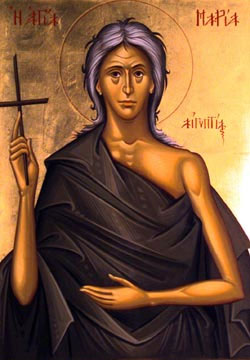
1 April ~ St. Mary of Egypt

When Mary was only twelve years old, she left her parents and departed to Alexandria, where she lived a depraved life for seventeen years. Then, moved by curiosity, she went with many pilgrims to Jerusalem, that she might see the Exaltation of the venerable Cross. Even in the Holy City she gave herself over to every kind of licentiousness and drew many into the depth of perdition. Desiring to go into the church on the day of the Exaltation of the Cross, time and again she perceived a certain invisible power preventing her entrance, whereas the multitude of people about her entered unhindered. Therefore, wounded in heart by this, she decided to change her way of life and reconcile herself to God by means of repentance. Invoking our Lady the Theotokos as her protectress, she asked her to open the way for her to worship the Cross, and vowed that she would renounce the world. And thus, returning once again to the church, she entered easily. When she had worshipped the precious Wood, she departed that same day from Jerusalem and passed over the Jordan. She went into the inner wilderness and for forty-seven years lived a most harsh manner of life, surpassing human strength; alone, she prayed to God alone. Toward the end of her life, she met a certain hermit named Zosimas, and she related to him her life from the beginning. She requested of him to bring her the immaculate Mysteries that she might partake of them. According to her request, he did this the following year on Holy and Great Thursday. One year after this, Zosimas again went thither and found her dead, laid upon the ground, and letters written in the sand near her which said: “Abba Zosimas, bury here the body of wretched Mary. I died on the very day I partook of the immaculate Mysteries. Pray for me.” Her death is reckoned by some to have taken place in 378, by some, in 437, and by others, in 522. She is commemorated also on the Fifth Sunday of Great Lent. Her life was recorded by Saint Sophronius of Jerusalem.
Apolytikion in the Plagal of the Fourth Tone
In thee the image was preserved with exactness, O Mother; for taking up thy cross, thou didst follow Christ, and by thy deeds thou didst teach us to overlook the flesh, for it passeth away, but to attend to the soul since it is immortal. Wherefore, O righteous Mary, thy spirit rejoiceth with the Angels.
Kontakion in the Second Tone
By the toils of thy struggles, O God-inspired one, thou didst hallow the harshness of the desert. Wherefore, we glorify thy memory, as we honour thee with hymns, O Mary, glory of the righteous.

Reading by Holy Transfiguration Monastery – Brookline, MA
Apolytikion by Holy Transfiguration Monastery – Brookline, MA
Kontakion by Holy Transfiguration Monastery – Brookline, MA
Icon by Greek Orthodox Archdiocese of America

Eleventh Step of Humility

The eleventh step of humility is that a monk speaks gently and without laughter, seriously and with becoming modesty, briefly and reasonably, but without raising his voice.  Rule of St. Benedict

For Saint Benedict, an inner logic holds in the ascent toward attaining true humility.  All the steps are connected in the one ladder.  And so the eleventh step seems a natural extension of the tenth step.  Saint Benedict, in this passage, not only advocates avoiding laughter; he goes further and counsels the monk to speak gently, briefly, with few words, and always with sincere modesty.

Saint Benedict is not only concerned with the inner workings of the monk, but also with his external behavior, which often becomes a reflection of his inner state.  In the spiritual life, our interior and external conduct are intimately connected.  Saint Paul, in his letter to the Galatians, gives us an insight into humility’s eleventh step: “If you are guided by the Spirit, I say, and do not gratify the desires of the flesh.  For what the flesh desires is opposed to the Spirit…  Those who belong to Christ Jesus have crucified the flesh with its passions and desires.  If we live by the Spirit, let us also be guided by the Spirit.  Let us not become conceited, competing against one another, envying one another.”

Brother Victor-Antoine d’Avila-Latourrette
Blessings of the Daily, A Monastic Book of Days

31 March ~ St. Innocent of Alaska

Our father among the saints Innocent of Alaska, Equal-to-the-Apostles and Enlightener of North America (1797-1879), was a Russian Orthodox priest, bishop, archbishop, and Metropolitan of Moscow and all Russia. He is known for his missionary work, scholarship, and leadership in Alaska and the Russian Far East during the 1800s. He is known for his great zeal for his work as well as his great abilities as a scholar, linguist, and administrator. He was a missionary, later a bishop and archbishop in Alaska and the Russian Far East. He learned several native languages and was the author of many of the earliest scholarly works about the natives and their languages, as well as dictionaries and religious works in these languages. He also translated parts of the Bible into several native languages.

St. Innocent, né Ivan (John) Evseyevich Popov-Veniaminov, was born on August 26, 1797, into the family of a church server in the village of Anginskoye, Verkholensk District, Irkutsk province, in Russia. His father died when John was six.

In 1807, John entered the Irkutsk Theological Seminary. In 1817 he married, and on May 18, 1817 he was ordained deacon of the Church of the Annunciation in Irkutsk. He completed his studies in 1818. He was appointed a teacher in a parish school, and on May 18, 1821 he was ordained priest to serve in the Church of the Annunciation.
At the beginning of 1823, Bishop Michael of Irkutsk received instructions to send a priest to the island of Unalaska in the Aleutian Islands of Alaska. Father John Veniaminov volunteered to go, and on May 7, 1823, he departed from Irkutsk, accompanied by his aging mother, his wife, his infant son Innocent, and his brother Stefan. After a difficult one-year journey, they arrived at Unalaska on July 29, 1824.
After John and his family built and moved into an earthen hut, he undertook the construction of a church on the island and set about studying the local languages and dialects. He trained some of his parishioners in construction techniques and with them undertook the construction of a church, which was finished the following July.
Father John’s parish included the island of Unalaska and the neighboring Fox Islands and Pribilof Islands, whose inhabitants had been converted to Christianity before his arrival, but retained many of their pagan ways and customs. Father John often traveled between the islands in a canoe, battling the stormy Gulf of Alaska.
His travels over the islands greatly enhanced Father John Veniaminov’s familiarity with the local dialects. In a short time he mastered six of the dialects. He devised an alphabet of Cyrillic letters for the most widespread dialect, the Unagan dialect of Aleut and, in 1828, translated the Holy Gospel of St. Matthew and other church materials into that dialect, which were eventually published in 1840 with the blessing of the Holy Synod of the Russian Orthodox Church. In 1829, he journeyed to the Bering Sea coast of the Alaskan mainland and preached to the people there. In 1836, his travels even extended to the south, to the Ross Colony north of San Francisco and to the Spanish missions of northern California. At Ross Colony he conducted services at its small, wooden chapel.
In 1834, Father John was transferred to Sitka Island, to the town of Novoarkhangelsk, later called Sitka. He devoted himself the Tlingit people and studied their language and customs. His studies there produced the scholarly works Notes on the Kolushchan and Kodiak Tongues and Other Dialects of the Russo-American Territories, with a Russian-Kolushchan Glossary.
Innokentii (Innocent), Metropolitan of Moscow (1797-1879), called the “Apostle of Alaska”In 1838, Father John journeyed to St. Petersburg and Moscow, Russia, and Kiev, Ukraine, to report on his activities and request an expansion of the Church’s activities in Russian America. While he was there, he received notice that his wife had died. He requested permission to return to Sitka. Instead, it was suggested that he take vows as a monk. Father John at first ignored these suggestions, but, on November 29, 1840, made his vows. He chose the name Innocent in honor of Bishop Innocent of Irkutsk.
On December 15, 1840, Archimandrite Innocent Veniaminov was consecrated Bishop of Kamchatka and Kuril Islands in Russia and the Aleutian Islands in Russian America. His see was located in Novoarkhangelsk, which he returned to in September 1841. He spent the next nine years in the administration of his see as well as on several long missionary journeys to its remote areas. On April 21, 1850, Bishop lnnocent was elevated to Archbishop. In 1852, the Yakut area was admitted to the Kamchatka Diocese, and in September 1853, Archbishop Innocent took up permanent residence in the town of Yakutsk. Innocent took frequent trips throughout his enlarged diocese. He devoted much energy to the translation of the scriptures and service books into the Yakut (Sakha) language.
In April 1865, Archbishop Innocent was appointed a member of the Holy Governing Synod of the Church.
On November 19, 1867, he was appointed the Metropolitan of Moscow, replacing his friend and mentor, Filaret, who had died. While there, he undertook revisions of many Church texts that contained errors, raised funds to improve the living conditions of priests and established a retirement home for priests.
Innocent died on March 31, 1879. He was buried on April 5, 1879, at Troitse-Sergiyeva Lavra.

On October 6, 1977, the Church of Russia, acting on the official request of the Orthodox Church in America, proclaimed Innocent a saint. His feast day is celebrated twice a year — on October 6 and March 31.

In 1994, during excavations on the grounds near the Holy Ghost Church at the Troitse-Sergiyeva Lavra, St. Innocent’s relics were discovered and are now venerated by the faithful both in Russia and America.

Source

error: Content is protected !!