Forgiveness Sunday

Forgiveness Sunday, also called Cheesefare Sunday, is the final day of pre-Lent. It is the Sunday after Meatfare Sunday and the Sunday before the Sunday of Orthodoxy.

On this last Sunday before Great Lent, the last day that traditionally Orthodox Christians eat dairy products until Easter, the Church remembers the expulsion of Adam and Eve from Paradise. God commanded them to fast from the fruit of a tree (Gen. 2:16), but they did not obey. In this way Adam and Eve and their descendants became heirs of death and corruption.

On Forgiveness Sunday many attend Forgiveness Vespers on the eve of Great Lent. They hear on the Lord’s teaching about fasting and forgiveness and enter the season of the fast forgiving one another so that God will forgive them. If you forgive men their trespasses, your heavenly Father will forgive you; but if you do not forgive men their trespasses, neither will your heavenly Father forgive you your trespasses (Matthew 6:14).
The Gospel reading of the day also gives advice on fasting. Moreover, when you fast, do not be like the hypocrites, with a sad countenance. For they disfigure their faces that they may appear to men to be fasting. Assuredly, I say to you, they have their reward. But you, when you fast, anoint your head and wash your face, so that you do not appear to men to be fasting, but to your Father who is in the secret place; and your Father who sees in secret will reward you openly. (Matthew 6:16-18).

After the dismissal at Vespers, The priest stands beside the analogion, or before the ambon, and the faithful come up one by one and venerate the ikon, after which each makes a prostration before the priest, saying “Forgive me, a sinner.” The priest also makes a prostration before each “God forgives. Forgive me.” The person responds, “God forgives” and receives a blessing from the priest. Meanwhile the choir sings quietly the Irmoi of the Paschal Canon, or else the Paschal Stichera. After receiving the priests blessing, the faithful also ask forgiveness of each other.

Kontakion (Tone 6)

Master, Teacher of wisdom,
Bestower of virtue,
You teach the thoughtless and protect the poor:
Strengthen and enlighten my heart.
Word of the Father,
Let me not restrain my mouth from crying to you:
Have mercy on me, a transgressor,
O merciful Lord!

From www.orthodoxwiki.com

IOCC Supports Earthquake Relief Efforts Of The Greek Archdiocese Of New Zealand

Baltimore, MD (IOCC) — As survivors begin to piece back their lives in the New Zealand city of Christchurch following a 6.3 magnitude quake that struck on February 22, the Greek Orthodox Archdiocese of New Zealand has initiated efforts to provide assistance to those who have lost homes and places of work. The death toll in Christchurch stands at 148, but authorities expect it to rise to near 200.
IOCC is working to support relief efforts personally led by His Eminence Archbishop Amfilochios of the Greek Orthodox Archdiocese of New Zealand and Exarch of Oceania who visited Christchurch just days after the initial quake to assess the damage and the needs of the people. Emergency supplies such as water, blankets, food and other essential items are being provided for families affected by the earthquake.
The IOCC response is being coordinated through the Chancellor of the Archdiocese in New Zealand, Fr. Christodoulos Papadeas, who previously served at Brotherhood of St. George in Denver, Colo. Also providing support is Fr. Amphilochios Basiltiotellis of the Dormition of the Virgin Mary parish in Christchurch.
Fr. Paul Patitsas, who previously served parishes in Rocky River, Ohio and Albuquerque, New Mexico, is part of IOCC’s Emergency Response Network and is working with IOCC directly to manage the response. The “Frontline” as the network is known, is made up of Orthodox clergy and laity volunteers who are trained and experienced in emergency response.
Christchurch is home to three Orthodox Christian churches. Still unconfirmed is the death of a Serbian woman who was a recent émigré from Serbia to New Zealand who remains trapped in the rubble. Fr. Patitsas reports that many suffered extensive damage to their homes and have lost their places of work. The relief efforts will assist both Orthodox and non-Orthodox people who have been affected by the quake.
IOCC, founded in 1992 as the official humanitarian aid agency of the Standing Conference of Canonical Orthodox Bishops in the Americas (SCOBA), has implemented programs in more than 35 countries around the world.
You can help the victims of disasters around the world, like those in New Zealand, by making a financial gift to the IOCC International Emergency Response Fund, which will provide immediate relief as well as long-term support through the provision of emergency aid, recovery assistance and other support to help those in need. To make a gift, please visit www.iocc.org, call toll free at 1-877-803-IOCC (4622), or mail a check or money order payable to IOCC, P.O. Box 630225, Baltimore, Md. 21263-0225.

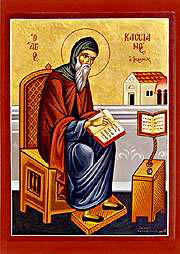
28 February ~ St. John Cassian

Our venerable and God-bearing Father John Cassian was a 4th/5th century monastic saint known for his writings on the monastic life and for correctives of the anti-Pelagian writings of St. Augustine of Hippo. His feast day in the Orthodox Church is February 29 (celebrated on February 28 in non-leap years), and it is also kept locally in Marseilles, France, on July 23.

St. John was born in the Danube Delta in what is now Dobrogea, Romania, in about 360 (some sources instead place him as a native of Gaul). In 382 he entered a monastery in Bethlehem and after several years there was granted permission, along with his friend St. Germanus of Dobrogea, to visit the Desert Fathers in Egypt. They remained in Egypt until 399, except for a brief period when they returned to Bethlehem and were released from the monastery there.

Upon leaving Egypt they went to Constantinople, where they met St. John Chrysostom, who ordained St. John Cassian as a deacon. He had to leave Constantinople in 403 when Chrysostom was exiled, eventually settling close to Marseilles, where he was ordained priest and founded two monasteries, one for women and one for men.
St. John’s most famous works are the Institutes, which detail how to live the monastic life, and the Conferences, which provide details of conversations between John and Germanus and the Desert Fathers. He also warned against some of the excesses in St. Augustine of Hippo’s theology whilst refraining from criticising him by name. For this reason he has sometimes been accused of Semi-Pelagianism by the Roman Catholic Church and some Protestant commentators.
St. John died peacefully in 435.

Troparion (Tone 8)

Having cleansed yourself through fasting,
You attained the understanding of wisdom,
And from the desert fathers You learned the restraint of the passions.
To this end through your prayers grant our flesh obedience to the spirit.
For you are the teacher, O venerable John Cassian,
Of all who in Christ praise your memory.

Sunday of the Last Judgment

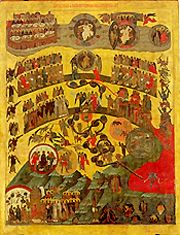
The foregoing two parables — especially that of the Prodigal Son — have presented to us God’s extreme goodness and love for man. But lest certain persons, putting their confidence in this alone, live carelessly, squandering upon sin the time given them to work out their salvation, and death suddenly snatch them away, the most divine Fathers have appointed this day’s feast commemorating Christ’s impartial Second Coming, through which we bring to mind that God is not only the Friend of man, but also the most righteous Judge, Who recompenses to each according to his deeds.
It is the aim of the holy Fathers, through bringing to mind that fearful day, to rouse us from the slumber of carelessness unto the work of virtue, and to move us to love and compassion for our brethren. Besides this, even as on the coming Sunday of Cheese-fare we commemorate Adam’s exile from the Paradise of delight — which exile is the beginning of life as we know it now — it is clear that today’s is reckoned the last of all feasts, because on the last day of judgment, truly, everything of this world will come to an end.
All foods, except meat and meat products, are allowed during the week that follows this Sunday.
Resurrectional Apolytikion in the Grave Tone
By means of Your Cross, O Lord, You abolished death. * To the robber You opened Paradise. * The lamentation of the myrrhbearing women You transformed, * and You gave Your Apostles the order to proclaim to all * that You had risen, O Christ our God, * and granted the world Your great mercy.
Resurrectional Kontakion in the Grave Tone
No longer will death’s dominion have power to detain mortal men. For Christ went down and smashed and destroyed its powers. Now Hades is bound, and the Prophets in unison exult and declare: The Savior has appeared to those with faith. Come out, you faithful, to the Resurrection.
Seasonal Kontakion in the First Tone
O God, when You come upon the earth in glory, the whole world will tremble. A river of fire will bring all before Your Judgment Seat and the books will be opened, and everything in secret will become public. At that time, deliver me from the fire which never dies, and enable me to stand by Your right hand, O Judge most just.

www.goarch.org

27 February ~ St. Raphael of Brooklyn

St. Raphael (Hawaweeny), the first Orthodox bishop consecrated in the New World, was born in Beirut, on or near the Synaxis of the Archangels, November 8, 1860, to pious Orthodox parents, Michael and Mariam Hawaweeny. Due to the violent persecution of the Christians of Damascus in July, 1860, which saw the martyrdom of the Hawaweeny family’s parish priest, the New-Hieromartyr Joseph of Damascus, and hundreds of their neighbors (all are commemorated on July 11), Michael and his pregnant wife Mariam fled from Damascus to Beirut. It was here that the future saint first saw the light of day. Indeed as the child’s life unfolded, it was evident that he would have no continuing city in this world, but would seek the city which is to come (Hebrews 13:14).

He received his primary and secondary education in the parochial schools of Damascus, and his first theological training at the Oecumenical Patriarchate’s Theological School at Halki in the Princes Islands. He later studied at the Kiev Theological Academy in Imperial Russia. During this time, the Syro-Arab community in the United States was growing at an increasing rate. A Syrian Orthodox Benevolent Society was organized in New York City and the president, Dr. Ibrahim Arbeely, contacted St. Raphael, then a priest, about coming to the United States. St. Raphael met with Bishop Nicholas in St. Petersburg and in 1895 returned with him to the United States to serve the Syro-Arab community. St. Raphael was placed in charge of the entire Syrian Orthodox Mission. He was assigned to New York City and organized the parish which later became St. Nicholas Cathedral in Brooklyn. He supervised the development of other Syrian communities, traveling widely through the United States in 1896 to organize parishes. By 1898, St. Raphael published a large Arabic Service Book for use in his churches. Later in the same year, he was to be the ranking representative of the American Mission to greet St. Tikhon (Bellavin), the new diocesan bishop. At the Liturgy on December 15, 1898, he spoke of St. Tikhon’s mission in his sermon. “He has been sent here to tend the flock of Christ – Russians, Slavs, Syro-Arabs, and Greeks -which is scattered across the entire North American continent.”

St. Tikhon recognized his qualities and wanted St. Raphael to be one of his vicar-bishops in the reorganized diocese. In 1903, St. Tikhon went to Russia and asked the Holy Synod to approve his plan for the election of St. Raphael as his vicar-bishop. They approved St. Raphael’s election and also consecrated Bishop Innocent (Pustynsky) as St. Tikhon’s vicar-bishop for Alaska. On March 12, 1904, the solemn rite of the election of St. Raphael as Bishop of Brooklyn was performed by St. Tikhon and Bishop Innocent at the Russian St. Nicholas Cathedral in Manhattan after the Vigil. The consecration took place the next day at the Syrian St. Nicholas Church in Brooklyn, with St. Raphael making his Confession of Faith both in Slavonic and Arabic.

Following his consecration, St. Raphael continued his work among the Syrian Orthodox and also helped St. Tikhon and his successors to administer the North American Mission. St. Raphael presided at the clergy conference held in Old Forge, Pennsylvania, on August 2, 1905, in the absence of St. Tikhon. He also consecrated the grounds of St. Tikhon’s Monastery in South Canaan, Pennsylvania, the first Orthodox monastery in the New World. He founded the magazine The Word Magazine in 1905. After twenty years of service in North America, St. Raphael fell asleep in Christ at his residence next to his cathedral on Pacific Street in Brooklyn on February 27, 1915. At the time of his repose, he administered thirty Syrian Orthodox congregations with 25,000 faithful.

St. Raphael’s sacred relics were first interred in a crypt beneath the holy table at his St. Nicholas Cathedral (March 7, 1915), later buried in the Syrian Section of Brooklyn’s Mt. Olivet Cemetery (April 2, 1922), and finally translated to Holy Resurrection Cemetery at the Antiochian Village near Ligonier, Pennsylvania (August 15, 1988). His sanctity was officially proclaimed on March 29, 2000, and his glorification celebrated on May 29, 2000, at St. Tikhon’s Monastery.

Today a splendid festival dawns upon the whole world. Today the lands of Russia and ancient Syria celebrate the memory of their righteous son Raphael, apostle to America, good shepherd of the lost sheep. Wherefore, let us celebrate this festive day and cry out unto him, saying: Rejoice, O new Moses, who didst lead thy people out of the wilderness into the Promised Land! Rejoice, O new Elias, who hast placed within the holy Church a double portion of thy spirit! Rejoice, O new Ezra, thou builder of the Temple of God! Rejoice, O new Apostle of Christ our God, the fisher of men! As thou hast boldness with the Angels before the throne of God, never cease to intercede with Christ God for thy holy flock.

Saturday of the Souls

Each year, before the start of the Great Lent, we commemorate the dead on the Saturday of the Souls.  This is the day that all of the names of those who have gone before us are read aloud in the Church and we sing Memory Eternal.  It is the job of the living to keep the memory of those who have gone before us alive so generation to generation will remember them.
The following description is taken from the website of the Greek Archdiocese and is a great description of the Saturday of the Souls:
Through the Apostolic Constitutions (Book VIII, ch. 42), the Church of Christ has received the custom to make commemorations for the departed on the third, ninth, and fortieth days after their repose. Since many throughout the ages, because of an untimely death in a faraway place, or other adverse circumstances, have died without being deemed worthy of the appointed memorial services, the divine Fathers, being so moved in their love for man, have decreed that a common memorial be made this day for all pious Orthodox Christians who have reposed from all ages past, so that those who did not have particular memorial services may be included in this common one for all. Also, the Church of Christ teaches us that alms should be given to the poor by the departed one’s kinsmen as a memorial for him.
Besides this, since we make commemoration tomorrow of the Second Coming of Christ, and since the reposed have neither been judged, nor have received their complete recompense (Acts 17:31; II Peter 2:9; Heb. 11:39-40), the Church rightly commemorates the souls today, and trusting in the boundless mercy of God, she prays Him to have mercy on sinners. Furthermore, since the commemoration is for all the reposed together, it reminds each of us of his own death, and arouses us to repentance.
Apolytikion in the Plagal of the Fourth Tone
Only Creator who out of the depths of wisdom lovingly govern all things and upon all bestow what is accordingly best for them, give rest to the souls of Your servants, for they have placed their hope in You, our Author and Maker and God.
Kontakion in the Plagal of the Fourth Tone
Give rest, O Christ, among the Saints to the souls of Your servants, where there is no pain, no sorrow, no grieving, but life everlasting.

Should the US Intervene in Lybia?

Yesterday, whilst reading my monring blogs, I was listening to a radio program.  The topic of the drive time radio was Should the US Intervene in Lybia?  Many folks called in with all sorts of answers and reasons and most were well thought out and articulated.  That got me to thinking.  What did I think about this?

I believe that the Government of the United States needs to protect her citizens if they are in danger.  If her citizens are stuck in Lybia due to the unrest, then the government needs to do what it needs to do to make sure they are safe and if needed evacuate them.  However, that is as far as I think we should take it.

I understand all the arguments.  And yes there is extreme suffering there, but we cannot and should not intervene in this present conflict.  Civil War or Civil demonstrations whatever we want to call this, needs to be organic if it is going to really change things.  All of this going on in the Middle East reminds me of the events of the late 80’s early 90’s in Eastern Europe.  These things need to grow on their own and go in the direction they need to go in.  Should we support this?  Yes.  can we place pressure on the leaders?  Yes.  In fact we did that in Egypt.

So what say you?  What should we do?

Pray for the safety of those in Lybia and pray for peace!

23 February ~ St. Boisil

Abbot of Melrose Abbey, Scotland, d. 664.
Almost all that is known of St. Boisil is learnt from Bede (Eccles. Hist., IV, xxvii, and Vita Cuthberti). He derived his information from Sigfrid, a monk of Jarrow, who had previously been trained by Boisil at Melrose.
St. Boisil’s fame is mainly due to his connection with his great pupil, St. Cuthbert, but it is plain that the master was worthy of the disciple. Contemporaries were deeply impressed with Boisil’s supernatural intuitions. When Cuthbert presented himself at Melrose, Boisil exclaimed “Behold a servant of the Lord”, and he obtained leave from Abbot Eata to receive him into the community at once…
When in the great pestilence of 664 Cuthbert was stricken down, Boisil declared he would certainly recover. Somewhat later Boisil himself as he had foretold three years before, fell a victim to this terrible epidemic, but before the end came he predicted thatCuthbert would become a bishop and would effect great things for the Church. After his death Boisil appeared twice in a vision to his former disciple, Bishop Ecgberht. He is believed, on somewhat dubious authority, to have written certain theological works, but they have not been preserved. St. Boswell’s, Roxburghshire, commemorates his name. His relics, like those of St. Bede, were carried off to Durham in the eleventh century by the priest Ælfred. In the early Calendars his day is assigned to 23 February, but the Bollandists treat of him on 9 September.

Continue In What You Have Learned and Firmly Believed

V. Rev. Fr. Nicholas Apostola
St. Nicholas Orthodox Church

This week we begin the Triodion, the Church’s hymn book for Great Lent leading to Pascha. While Lent is still a few weeks off, the Fathers decided to help us get ready for it by focusing our attention through Scripture readings and hymns. Today’s Gospel lesson is the parable of the the Publican (tax collector) and the Pharisee (Luke 18:10-14). The Epistle reading is from St. Paul’s second letter to Timothy, 3:10-15.
The selected reading comes out of a portion of the Letter concerned with the End-Times, that is, the Second Coming of Jesus. St. Paul is predicting what will happen to people as the time for the Lord’s arrival draws near. He is particularly trying to encourage and strengthen his beloved disciple Timothy, who we learn from St. Paul’s letters and in Acts, is a quiet and retiring person, not the kind of strong personality that St. Paul is himself.
The first thing that St. Paul offers Timothy is his own example. He has done this in other situations as well, for example when he tells the Corinthians that they might have many teachers but not may fathers (1 Cor 4:15); or when he tells them to “be imitators of me as I am of Christ” (1 Cor 11:1). So, in a more gentle way, he says to Timothy: “You have observed my teaching, my conduct, my aim in life, my faith, my patience, my love, my steadfastness, my persecutions, and my suffering the things that happened to me in Antioch, Iconium, and Lystra. What persecutions I endured! Yet the Lord rescued me from all of them.” (v. 10-11) St. Paul had suffered in many places, but in this passage he only mentions those places that Timothy would personally remember, especially Lystra, where St. Timothy was born, raised, and first met St. Paul.
He then tells Timothy a sobering reality: “All who want to live a godly life in Christ Jesus will be persecuted.” (v. 12) He is speaking first and foremost out of his own personal experience. While a committed disciple of the Jewish leadership in Jerusalem, he persecuted the followers of Christ mercilessly. When Jesus appeared to him and he then became a follower of Jesus, he himself became the one persecuted. In our own time Christian believers are being firebombed and killed even in their own Churches, in Nigeria, Egypt, Iraq, Iran, and Indonesia — only to mention a few places. For them and others a choice to openly confess their faith in Jesus Christ may very well mean a choice to suffer and die. Not so many years ago the same was true in all of the Eastern Bloc.
This is not to say that people of other faiths do not also suffer persecution — sometimes at the hands of ‘Christians’ — but suffering because of faith in the person and teachings of Jesus the Christ has distinguished His followers throughout the centuries. Most of us have grown up in a political environment where we have never had to choose between our lives and our faith. Unfortunately, from the outset, many Christians have. Regardless, it is never easy to be Christian. While we might not be asked by others to put our lives on the lines, we are still asked by the Lord Himself to die to ourselves in order to truly live, in Christ.
The second point, a corollary, is that: “wicked people and impostors will go from bad to worse, deceivers and deceived.” (v. 13) One of the titles of the devil is the “Deceiver.” It was through his deception that Eve took the fruit in the Garden. It was she who naïvely deceived Adam to share in it. (cf. Genesis 3:1ff) St. Paul speaks of a cycle of evil and wickedness. One feeds on the other. It becomes difficult, if not impossible, to stop. Only with God is it possible to break this cycle. (cf. Matthew 19:25-26)
St. Paul offers this instruction to Timothy, both to strengthen his resolve in the face of persecution as well as to prepare him to face the wickedness of the world. “Continue in what you have learned and firmly believed, knowing from whom you learned it, and how from childhood you have known the sacred writings that are able to instruct you for salvation through faith in Christ Jesus.” (v. 14-15)
Timothy’s mother was a pious Jewish woman married to a pagan. Theirs was what we might call today a “mixed marriage.” Nevertheless, she educated Timothy according to Jewish tradition; beginning from age five all children were to be instructed in the Sacred Writings. Even while recommending the study of Scripture, St. Paul also emphasizes the role of the people who taught him. We can presume that he meant his mother. Just as he had offered himself as an example to follow, so too is he now reminding Timothy of his mother’s example of faith. As parents we are the primary example our children look to for everything, but especially regarding our faith; the way we integrate and manifest what we say we believe with how we actually behave is what our children will remember.
Finally he reiterates the power of Scripture to “instruct for salvation.” Until recently it was common for children to memorize Scripture, and especially the Psalms. One requirement for ordination to the episcopacy is to be able to recite the entire Books of Psalms by heart. Verses of the Sacred Text that are engraved on our hearts come to our aid when we are struggling and in need of consolation. “Through our faith in Christ Jesus” the comforting words inspired by the Holy Spirit bring peace to our hearts and salvation to our souls.
Maranatha! (“Lord, come!”)

error: Content is protected !!