Sunday of Orthodoxy Vespers
![]() |
| Sunday of Orthodoxy Icon |
Congressman Darrell Issa (R-CA) on Religious Freedom
![]() |
| Rep. Darrell Issa (R-CA) |
Date: Feb. 16, 2012
Location: Washington, DC
Americans of all faiths have a right to practice their religion free from the fear of persecution or harassment from their government. Our nation’s founders believed this and enshrined religious freedom into the First Amendment to the Constitution.
While some Americans may not feel that government mandates forcing them to pay for contraception are an infringement on their religious beliefs, others consider it to be an assault against their freedom of conscience. A government policy that encroaches on the conscientious objections of religious groups concerns all Americans who value the protections of the First Amendment. Today, the committee will hear testimony from leaders of different faiths. They are concerned that government, under this Administration, is encroaching on their First Amendment rights.
The Administration’s actions have forced us to confront a more fundamental question about the proper role of government in our lives.
This hearing is about basic question of religious freedom, and whether or not protection will be afforded to religious institutions who wish to follow their conscience in refusing to pay for products they find morally objectionable. I look forward to hearing from today’s witnesses.
Sunday of Orthodoxy Sermon
Glory to Jesus Christ! Glory Forever!
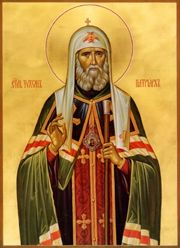
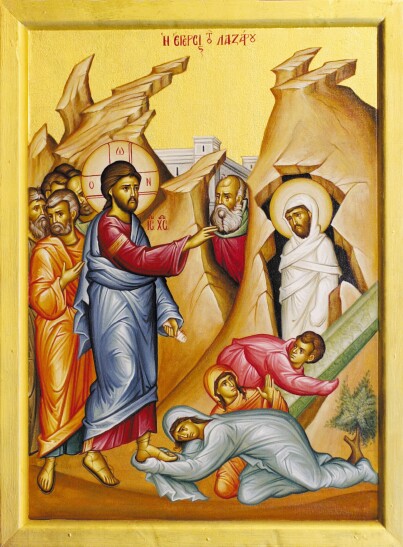
Today we commemorate the restoration of the Icons that took place at the 7th Ecumenical Council in 787. Prior to this Council Icons had been declared Idols and therefore were not allowed to be used or created. Many of the images from those early days had been destroyed, although some were saved by hiding them in various places. Today, on this first Sunday of the Great Lent, we remember that day and reaffirm our belief is what is Orthodox. At the close of the Liturgy we will recite the Synodal Affirmation of Faith, which is found in the bulletin. Tonight we will gather with Orthodox Christians from all over Worcester County to celebrate this feast day.
A Monk is to be Dead to the World
A monk is to be dead to the world, for by his very vocation he is called to be set apart, living a life in imitation of the angels. Whether he be praised or offended, a monk must react as though he were a dead man. He must not be disturbed by insults, nor prideful when people praise him.
In his obedience and humility, he finds beauty in a hidden life.
Abbot Tryphon of Vashon Island
3 March ~ St. Non of Wales
2 March ~ St. Chad of Lichfield
Our father among the saints Chad of Lichfield and Mercia (+672) also called St. Caedda was a missionary, bishop, healer, and wonderworker who spread the Orthodox Catholic Faith throughout the British Isles. His feast day is commemorated on March 2.
Everything we know of this great hierarch comes from the writings of St. Bede in his “Ecclesiastical History”, written in 731.
St. Chad, the youngest of four brothers, was born into a humble Northumbrian family near the beginning of the seventh century. His brothers, St. Cedd, St. Cynebil and righteous Caelin all became monks. A family of saints, these four men studied under the great sainted-hierarch and monk, Aidan of Lindisfarne. Saint Aidan was a great source of spiritual insight to these four men, all four became priests of the holy Church. They were sent to Ireland under the great geronda (elder) and saint, Egbert, at the monastery of Rathmelsige (Melfont), for advanced study and training in the monastic life.
Chad worked tirelessly with his brother Cedd (who had been made bishop of London), they established the monastery of Laestingaeu, now Lastingham in Yorkshire. Upon the death of his brother Cedd in 664, Chad succeeded him as abbot.
St. Wilfrid was chosen to become bishop of Lindisfarne after the death of bishop Tudi. He travelled to Gaul for consecration and remained so long absent that King Oswiu (ruler of Northumbria) demanded a bishop. Having learned of the missionary exploits and great humility of Chad, called for his election as Bishop of York, to which place the See of Lindisfarne had been transferred.
St. Chad was consecrated (uncanonically) by Bishop Wini of Worcester and two schismatic British bishops to the See of York.
Saint Chad was hesitant to be bishop, he wanted no part of it, but ultimately he was obedient. As bishop of York, he was much beloved by his flock, travelling great distances on foot to care for his “little sheep.” When St. Wilfrid returned to York and found out his See was given away, he made no objection and retired to a monastery in peace. Saint Chad, a Celtic Bishop, played a huge role in unifying the Church in 664 by accepting and recommending to his fellow bishops the adoption of the Orthodox Nicaean calendar.
In the year 668, Saint Theodore of Tarsus assumed the central Cathedra and became Archbishop of Canterbury and immediately sought about reforming the churches in England and Ireland. Up until this time, the Church in the Isles was not following proper canonical order set down by the Ecumenical Councils. St. Theodore of Tarsus was sent by the Pope of Rome to restore order in the British and Irish churches. Saint Theodore was a wise bishop and a deeply spiritual monastic. While travelling to York he was shocked to find that St. Wilfrid was not the canonical bishop of York. The consecration of St. Chad was uncanonical due to three points made by St. Theodore:
1. The British bishops refused to acknowledge the canonical (Julian) Church calendar established by the Ecumenical Council of Nicea (of which Rome and the four Eastern Patriarchates adhered to)
2. The bishops were out of communion with the Universal Church.
3. An improperly performed consecration ceremony.
St. Theodore decided that in good church order, St. Chad must give up the See of York to it’s rightfully elected bishop, St. Wilfrid. St. Chad in astounding humility responded, “If you decide that I have not rightly received the episcopal character, I willingly lay down the office; for I have never thought myself worthy of it, but under obedience, I, though unworthy, consented to undertake it.” Seeing in him a true bishop, a man of such humble and angelic character, St. Theodore pleaded with Chad to continue in his archpastoral ministry. St. Theodore provided what was lacking from St. Chad’s consecration (“ipse ordinationem ejus denuo catholica ratione consummavit” – Bede, Hist. Eccl. IV, 2) and completed the rite according to the Orthodox Roman Rubricon. St. Wilfrid remained as bishop of York and St. Chad returned to his monastery in Lastingham.
In 669, King Wulfere demanded a bishop for his people in Mercia. St. Chad was called on by St. Theodore of Tarsus to be archpastor of the Mercian people. Mercia was a land of deeply rooted pagan beliefs, and a large area at that. St. Chad considered this to be his true work, bringing the Mercian people to Christ. He soon discovered that a great persecution occurred on the plains of Lichfield, deep within the Mercian lands. The Roman emperor Diocletian had exterminated 1000 martyrs on the plains of Lichfield in the year 303A.D, they are known as the Martyrs of Lichfield. St. Chad considering this to be a holy place moved the See of Mercia from Repton to the exact spot of the massacre in Lichfield, where his new diocesan Cathedral and Monastery were to built. St. Chad is considered the first bishop of Lichfield.
As Bishop of Lichfield, Chad carried out his missionary and pastoral work with zeal. The kingdom of Mercia was huge, and Chad spent much of his time travelling by foot. In accordance with the Celtic tradition, in which he had been brought up, he at first insisted on making all journeys on foot, following the example of the apostles. However, St. Theodore insisted that Chad used a horse for long journeys. St. Chad, unwilling to do anything that he felt would put him above the common man, refused, but Theodore, St. Bede tells us, “lifted Chad bodily onto the horse himself.”
His exploits were known throughout all Mercia, St. Chad was known to have retired, from time to time, to the bottom of a smalll well where he could contemplate and “pray without ceasing.” The people would say that they knew when St. Chad was in his well, “a light like that of the sun, would shine from the bottom of the well.” St. Chad was seen in the uncreated light by countless many. His humble prayers could easily cure illnesses and demonic possession. A gifted man of prayer he was also a source of forgiveness even to those who would seek his destruction.
King Wulfere was a pagan, but also a good statesman. He used Christianity to control his subjects, he secretly despised the Faith. One day, the sons of Wulfere, Princes Wulfade and Ruffin were out hunting a dear near the saint’s cell, when they approached the saint and asked about “the One called Jesus”. So struck by the holy elder’s words they both asked to be immediately baptised into Christ’s holy Church. Wulfere, so enraged by the actions of his sons, killed them with his own hands. Afterwards, filled with such remorse the King suffered in both body and spirit by the loss of his children. He was counselled by his queen to ask the holy elder to forgive him and to hear his confession. As he approached the holy hierarch’s cell he was witness to a great sight, the uncreated light of Tabor that shown upon the saint’s visage. The king fell down in prostrate and begged his forgiveness and to truly bring him into the Orthodox Christian faith. As a penance for the murder of his children, the saint told him to build churches and monasteries in the name of Jesus Christ. He did so, and up until the end of the saint’s earthly life, King Wulfere remained a humble servant of the holy elder.
Owini, a novice monk under St. Chad’s care, was working alone in the fields near Chad’s residence. When he heard the sound of singing apparently descending from the sky to the rectory where the saint was praying. The angelic chanting could be heard for half an hour before returning heavenwards. Chad then summoned his monks and, after urging them to live good Christian lives and to continue in keeping the rules of monastic discipline, announced that he would soon die. When the other fathers had gone away, Owini returned to Chad and begged to know what the singing had been that he had heard. St. Chad replied that he had been visited by angelic hosts summoning him to heaven and that the angels would return in seven days to take him to heaven. He then commanded the young monk to tell no one of this until after his death.
St. Chad was quickly taken ill (probably by the plague) and on the seventh day (March 2, 672), “his holy soul was released from the prison-house of the body and, one may rightly believe, was taken by the angels to the joys of heaven”. St. Chad was bishop of Lichfield and Mercia for just three years, his emulation of Christ ended as it began.
Bede goes on to tell us that he was called “saint” immediately after his death. Miracles and cures of all ailments occurred at the place of his death, his reliquary, his well and anywhere his holy relics travelled.
His holy relics are preserved in the Roman Catholic Cathedral that bears his name in Birmingham, England.
From OrthodoxWiki
Archbishop Nicolae’s Meditation for the Sunday of Orthodoxy
But not all of us know that this celebration of Orthodoxy was superimposed on the ancient commemoration of the Prophets Moses, Aaron, and Samuel, attested to at least since the time of Patriarch Germanos of Constantinople († 740). At that time Great Lent was full of biblical commemorations: in the 2nd week Noah was commemorated, in the 4th the sacrifice of Isaac, and in the 5th Isaac himself. Makarios of Simonopetra speaks in detail about these commemorations in his exceptional work on the Triodion.
The celebration of the prophets harmonized well with the 1st week of Great Lent and the Old Testament atmosphere of the readings during the services. Fortunately this celebration of the prophets was not eliminated, but remained in connection to the feast of Orthodoxy, being justified by the fact that the prophets anticipated and foretold the Incarnation of the Word to which the icons witness.
In his discourses on the icons, St. John of Damascus had already laid out the analogy that exists between them and the visions of the prophets. They did not see the visions they were granted with physical eyes, but with spiritual eyes, like the apostles on Mt. Tabor; and what they saw were “icons” of God, not His Being. These visions were “images” of what would be fully revealed through the Incarnation. Under the New Covenant those things that had served to prefigure were abolished and the prophets’ visions were replaced by icons. As we know, icons are based on the Incarnation of the Son of God, on the fact that God Himself was revealed to human beings. The prophets’ visions prefigured the Incarnation, “the natural Icon of the Father” (St. John of Damascus), so that they can be considered “icons of these icons” (Makarios of Simonopetra), and the prophets can rightly be celebrated together with the holy icons on the 1st Sunday of Great Lent.
By means of this double celebration, the Sunday of Orthodoxy reveals a wonderful work of God in the history of salvation. For if no one had seen God before the Incarnation, until He had taken on human nature, still the prophets foretold Him, seeing across time, actually before the time, the face of the Incarnate God. The Creator was awaiting “the fullness of time” in order to reveal Himself as Savior, but His chosen ones, the prophets, took part in this revelation in order to preserve the faith alive among the people.
May Christ the Lord grant us peace and spiritual joys, together with increased strength to ascend the steps of Holy Lent in a worthy manner toward the light-giving Resurrection!
Open Letter to IOCC
Here is the letter:
(Orthodoxy Today) – by Ronda Wintheiser – Dear Mr. Triantafilou, board of directors, and the staff at IOCC:I did finally receive a response to the email and the letter I wrote recently asking you to reconsider your selection of Senator Sarbanes as an honorary chairman for the upcoming gala planned for May 8th. Thank you for it.The letter read, in part, that: “Senator Sarbanes was selected as an honorary co-chairman for the event for his steadfast commitment and support for IOCC’s ongoing humanitarian mission. While we recognize that you do have concerns about his participation, we hope you will not allow it to overshadow a 20-year legacy of positively impacting the lives of so many people.”I’m sure you hoped that such a carefully crafted letter would smooth this over and make me go away. But it’s Great Lent, and one of the Scripture readings selected by the Church for Clean Monday just happens to be a warning from God about coming to worship Him with blood on our hands (Isaiah 1) — and I take that very seriously.Do you realize that the argument made in the letter written by Rada Tierney for why I should continue to support IOCC is the same argument used to defend Planned Parenthood? ‘So what if they are the largest abortion provider in the world? They do so much good! Why allow your concerns about abortion to overshadow their legacy of positively impacting the lives of so many people?’In Romans 16, St. Paul admonishes Christians to “associate with the lowly”. As far as I can tell, there are none so lowly as unborn children, nor as needy, isolated, and vulnerable, and as we are about to celebrate on March 25th, Christ deigned to become an unborn Child Himself.It isn’t my choice to overshadow your “20-year-legacy” with the spectre of abortion — it’s yours. You have made it clear it doesn’t matter to you whether Senator Sarbanes supports killing unborn children as long as he keeps giving his money to you. That makes it painfully obvious that you prefer to associate with rich, powerful, politically correct figures than with lowly unborn children — or with nobody housewives like me, for that matter.You have Senator Sarbanes’ support, so you surely don’t need mine; therefore, I am writing to request a refund of the $100 check I wrote to IOCC on February 5th during the Souper Bowl of Caring drive. It’s not very much; I’m sure you won’t miss it, and if you do, perhaps Senator Sarbanes will make up the difference.Lord, have mercy on me, and on you all as well.
1 March ~ St. David of Wales
Patron of Wales. Bishop and Confessor. Also known as Degui and Dewi.
He is usually represented standing on a little hill, with a dove on his shoulder. The earliest mention of St. David is found in a tenth-century manuscript Of the “Annales Cambriae”, which assigns his death to A.D. 601. He was prominent at the Synod of Brevi (Llandewi Brefi in Cardiganshire), which has been identified with the important Roman military station, Loventium…
Shortly afterwards, in 569, he presided over another synod held at a place called Lucus Victoriae. He was Bishop (probably not Archbishop) of Menevia, the Roman port Menapia in Pembrokeshire, later known as St. David’s, then the chief point of departure for Ireland.
This is all that is known to history about the patron of Wales. His legend, however, is much more elaborate, and entirely unreliable. The first biography that has come down to us was written near the end of the eleventh century, about 500 years after the saint’s death, by Rhygyfarch (Ricemarchus), a son of the then bishop of St. David’s, and is chiefly a tissue of inventions intended to support the claim of the Welsh episcopate to be independent of Canterbury.
According to various writers, St. David was the son of Sant or Sandde ab Ceredig ab Cunnedda, Prince of Keretica (Cardiganshire) and said by some to be King Arthur’s nephew. The saint’s mother was Nonna, or Nonnita (sometimes called Melaria), a daughter of Gynyr of Caergawch. She was a nun who had been violated by Sant. St. David’s birth had been foretold thirty years before by an angel to St. Patrick. It took place at “Old Menevia” somewhere about A.D. 454. Prodigies preceded and accompanied the event, and at his baptism at Porth Clais by St. Elvis of Munster, “whom Divine Providence brought over from Ireland at that conjuncture”, a blind man was cured by the baptismal water.
St. David’s early education was received from St. Illtyd at Caerworgorn (Llantwit major) in Glamorganshire. Afterwards he spent ten years studying the Holy Scripture at Whitland in Carmarthenshire, under St. Paulinus (Pawl Hen), whom he cured of blindness by the sign of the cross. At the end of this period St. Paulinus, warned by an angel, sent out the young saint to evangelize the British.
St. David journeyed throughout the West, founding or restoring twelve monasteries (among which occur the great names of Glastonbury, Bath, and Leominster), and finally settled in the Vale of Ross, where he and his monks lived a life of extreme austerity. Here occurred the temptations of his monks by the obscene antics of the maid-servants of the wife of Boia, a local chieftan. Here also his monks tried to poison him, but St. David, warned by St. Scuthyn, who crossed from Ireland in one night on the back of a sea-monster, blessed the poisoned bread and ate it without harm.
From thence, with St. Teilo and St. Padarn, he set out for Jerusalem, where he was made bishop by the patriarch. Here too St. Dubric and St. Daniel found him, when they came to call him to the Synod of Brevi “against the Pelagians”. St. David was with difficulty persuaded to accompany them; on his way he raised a widow’s son to life, and at the synod preached so loudly, from the hill that miraculously rose under him, that all could hear him, and so eloquently that all the heretics were confounded. St. Dubric resigned the “Archbishopric of Caerleon”, and St. David was appointed in his stead. One of his first acts was to hold, in the year 569, yet another synod called “Victory”, against the Pelagians, of which the decrees were confirmed by the pope.
With the permission of King Arthur he removed his see from Caerleon to Menevia, whence he governed the British Church for many years with great holiness and wisdom. He died at the great age of 147, on the day predicted by himself a week earlier. His body is said to have been translated to Glastonbury in the year 966.
It is impossible to discover in this story how much, if any, is true. Some of it has obviously been invented for controversial purposes. The twelve monasteries, the temptation by the women, the attempt on his life, all suggest an imitation of the life of St. Benedict. Wilder legends, such as the Journey on the Sea-Monster, are commonplaces of Celtic hagiography. Doubtless many writers collected many floating local traditions, but how much of these had any historical foundation and how much was sheer imagination is no longer possible to decide.