Parish Revitalization

Recently, whilst reading my daily list of blogs, I came across the website of All Saints of North America Russian Orthodox Church.On this site were two posts of interest on revitalization of an Orthodox parish.The pastor of the parish writes about an encounter with a Protestant minister who asks why the Orthodox Church does not have revival meetings.The priest responds that the Orthodox Church does not need revitalization.He goes on to say this because as Orthodox we are challenged daily to revitalize ourselves.
This set my mind to thinking so I read on in the article This is a great little piece on how we can get our spiritual life back on track.I sometimes feel that those of us involved in Church work as so consumed with numbers.How many people did we get at Liturgy on Sunday?How many come to Bible Study etc. In the last few months I have tried to shift beyond this and focus more on quality rather than quantity. We Orthodox do a wonderful job educating our children about the faith but a lousy job at educating the adults in our Churches. All one needs to do is read some of the so called Orthodox Blogs to find that theology is all over the map especially regarding morals.
The author of the previously mentioned article summarizes a report by Archbishop Antony of Los Angeles of the Russian Orthodox Church Outside of Russia. The report itself is from 1985 but still has some teeth today.
If we ever hope to revitalize our churches and our people they need to get back to reading the Scriptures and the Holy Fathers of the Church. The article quotes St. Ignaty Brianchaninov: “All the holy ascetic writers of the recent centuries of Christianity affirm that… the study of the Sacred Scriptures… and the writing of the Fathers, and careful and steadfast direction according to them is the only path to spiritual success.” He goes on to say that frequent confession is also necessary for salvation. We have lost the spirit of frequent confession and I for one hope we get it back, and soon.
It is no mistake that the Archbishop quotes from St. Ignaty. The saint was placed in charge of four monasteries that were in decline. We placed these monasteries under a rule of study of Sacred Scriptures and the fathers as well as frequent confession. The number of monks increased in all of the monasteries, a large flow of pilgrims began to arrive, and buildings had to be built to accommodate all of those who were coming. We need to get our parishioners excited about Scripture and the fathers and then we will see the quality, as well as the quantity of the people start to improve.
But what say you to a parishioner who claims to not have time to dedicate to Holy Readings? St. John Chrysostom has this to say,
“I have always suggested and will not stop suggesting that you not only heed what is said in church, but also constantly occupy yourself in reading the Divine Scriptures at home. I have always suggested this also to those who are with me in private. Let no one say to me those words, cold and worthy of all condemnation: I am busy with public matters, I practice my trade, I have a wife, I am raising children, I manage a household, I am a layman; it is not my job to read the Scriptures, but that of those who have renounced the world. No, it is your job more than theirs; because they do not have as much need of the help the Divine Scriptures as do those who turn to them in the midst of many tasks. Monks, who have distanced themselves from commotions, enjoy great safety, while we, excited as if in the midst of the sea and falling into a multitude of sins, we always need constant and uninterrupted consolation from the Scriptures. It is not possible, it is not possible for anyone to be saved who does not constantly practice spiritual reading; for if, receiving wounds every day, we will not constantly practice spiritual reading, then what hope have we of salvation? Let us begin collecting a treasury of spiritual books for ourselves. Even merely seeing such books makes us more restrained from sin. Physical beauty often arouses lack of control, but spiritual beauty disposes God Himself to love it. Let us develop this beauty through the daily washing away of every impurity by reading the Scriptures.
There are many more examples of this type but suffice it to say that we have work to do. If we hope to bring Orthodoxy to America, dare I say we must first bring Orthodoxy to the Orthodox?
Get them back into Holy Scripture and the Fathers, and we need to get the people back to confession this is very important.I think if we are able to do the hard work necessary we will be blessed with the outcome.

9 August ~ Venerable Herman of Alaska

Our venerable father Herman of Alaska (1756 – December 13, 1837) was an 18th century missionary to Alaska. He, in 1970, became the first saint to be glorified by the Orthodox Church in America, concurrent with parallel services in another location by the Russian Orthodox Church Outside Russia. St. Herman is remembered by the Church on August 9 and December 13.

Herman of Alaska was a Russian Orthodox monk from Valaam Monastery in Russia who traveled with eight other monks in 1793 to bring the Gospel to the native Aleuts and Eskimos in the Aleutian Islands. As part of the Russian colonization of the Americas, Russians had been exploring and trading there since at least 1740. Thus, he marks the first arrival of Orthodox Christian missionaries in North America. He built a school for the Aleutians, and he often defended them from the injustices and exploitation of the Russian traders. He was known to them as Apa which means “Grandfather.” He lived most of his life as the sole resident of Spruce Island, a tiny wooded island near Kodiak Island.

Orthodox Vocations

I have often thought that we in the Orthodox Church do not do enough to promote vocations to the Priesthood, Diaconate, and men’s and women’s monastic life.  It is the responsibility of every Orthodox Christian to not only pray for vocations but to actively promote them.  How many of our Churches have someone in the seminary preparing for a vocation in the Church?

Fr. John Peck has started a website, actually he started it sometime ago, specifically to aid in the promotion of vocations to the religious life in the Orthodox Church.  Good Guys Wear Black, Discerning Your Vocation in the Orthodox Church, is designed to help those thinking and praying about a vocation but also those of us who help promote them.

The site is chock full of resources and articles about the vocational journey.  There is an extensive media section with bulletin inserts and banners for websites.

Remember it is the job of all Orthodox Christians to promote vocations in the Church.

Just as a side note, if you are looking for a professionally designed website, Fr. John runs Logos Web Services, give them a try they do great work! 

5 August ~ St. Oswlad

King of Northumbria and Martyr.
Born, probably, 605; died 5 Aug., 642.

The second of seven brothers, sons of Ethelfrid, who was grandson of Ida, founder of the Kingdom of Northumbria in 547. Oswald’s mother was Acha, daughter of Ella or Alla, who, after Ida’s death, had seized Deira and thus separated it from the Northern Bernicia…

The years of Oswald’s youth were spent at home, as long as his father reigned, but when, in 617, Ethelfrid was slain in battle by Redwald, King of the East Angles, Oswald with his brothers fled for protection from Edwin, their uncle, Acha’s brother, to the land of the Scots and were cared for at Columba’s Monastery at Hii, or Iona. There they remained until Edwin’s death in the battle of Heathfield (633). Eanfrid, his elder brother, then returned to accept the Kingdom of Deira, whilst Osric, cousin of Edwin, received Bernicia. The kingdom was thus again divided and both parts relapsed into paganism. In the following year Osric was slain in battle, and Eanfrid treacherously murdered by the British king, Cadwalla.

Oswald thereupon came down from the North, and in 635 a small but resolute band gathered round him near the Roman Wall at a spot seven miles north of Hexham, afterwards known as Hevenfelt, or Heaven’s Field. Here, encouraged by a vision and promise of victory from St. Columba, who shrouded with his mantle all his camp, Oswald set up a cross of wood as his standard — the first Christian symbol ever raised in Bernicia — and gave battle to the Britons, who were led, probably, by Cadwalla. The Britons were completely routed, and thenceforth could only act on the defensive.

Oswald was thoroughly grounded in the principles of the Christian religion, and, though but twelve nobles with whom he returned from exile were Christians, far from abandoning his faith, his first care was to spread it among the Bernicians, thus confirming the political union effected by Edwin with a religious union unknown before. Edwin, it is true, had himself received the Faith in 627, through the influence of his wife Ethelburga, sister of the Kentish King, who had brought St. Paulinus to the North, but his example was followed only by the people of Deira.

Oswald, brought up in Columba’s monastery at Iona, naturally looked the North for missionaries. The first preacher who set forth soon returned, having found the Northumbrian people too barbarous and stubborn. Then Aidan was sent, “a man of singular meekness, piety and moderation”, who established his episcopal see at Lindisfarne, in 635.

Oswald’s zealous co-operation with the monk-bishop soon filled the land with churches and monasteries, and the church at York, begun by Edwin, was completed. Moreover, his wonderful humility in the midst of success, his charity, and his piety soon had their effect in turning his subjects from Woden to Christ. We are told that the king in his Court acted as the interpreter of the Irish missionaries who knew not the language of his thanes.

It was Oswald’s work to add to the warlike glory of his father Ethelfrid and the wise administration of his uncle Edwin the moral power of Christianity, and to build up a great kingdom. Edwin had gathered the whole English race into one political body and was overlord of every English kingdom save that of Kent.

The Venerable Bede (III, 6) says that Oswald had a greater dominion than any of his ancestors, and that “he brought under his sway all the nations and provinces of Britain, which are divided into four languages, namely the Britons, the Picts, the Scots, and the English”. He had great power in the North-West, as far south as Chester and Lancashire, and was probably owned as overlord by the Welsh Kingdom of Strath Clyde, as well as by the Picts and Scots of Dalriada. In the East he was supreme in Lindsey, and the words of Bede seem to imply that he was overlord of Mercia, which was still ruled by Penda; but this could have been scarcely more than nominal. The West Saxons in the South, influenced by the fear of Penda, readily acknowledged Oswald, their allegiance being strengthened, in 635, by the conversion of King Cynegils, of Wessex, at whose baptism Oswald stood sponsor, and whose daughter he married. Both sovereigns then established Bishop Birinus at Dorchester.

This vast supremacy, extending from north to south, and broken only by Penda’s kingdom in Mid-Britain and that of the East Angles, led Adamnan of Hii to call Oswald “The Emperor of the whole of Britain”. Christianity seemed to be forming a network round the pagan Penda of Mercia. The kingdom of the East Angles, which was still Christian, but acknowledged Penda as overlord, was necessary to Oswald to maintain the connection between his dominions in the north and the south. War was therefore inevitable.

At the battle of Maserfeld, said to be seven miles from Shrewsbury, “on the border of Wales, near Offa’s dyke”, Oswald was slain on 5 Aug., 642, and thus perished “the most powerful and most Christian King” in the eighth year of his reign and in the flower of his age.

His last words were for the spiritual welfare of his soldiers, whence the proverb: “God have mercy on their souls, as said Oswald when he fell.” His body was mutilated by Penda, and his limbs set up on stakes, where they remained a full year, until they were taken away by Oswy and given to the monks at Bardney in Lindsey. In the tenth century some of the bones were carried off by Ethelred and Ethelfleda of Mercia to St. Peter’s, Gloucester. His head was taken from the battlefield to the church of St. Peter in the royal fortress at Bamborough, and was afterwards translated to Lindisfarne, where, for fear of the Danes, it was placed in 875 in the coffin of St. Cuthbert, which found its resting place at Durham in 998. It was in the coffin at the translation of St. Cuthbert in 1104, and was thought to be there when the tomb was opened in 1828. His arm and hand (or hands) were taken to Bamborough and perhaps afterwards removed to Peterborough, and were still incorrupt in the time of Symeon of Durham, early in the twelfth century.

Reginald gives an account of his personal appearance: arms of great length and power, eyes bright blue, hair yellow, face long and beard thin, and his small lips wearing a kindly smile.

Oswald laboured to bring order and law to his kingdom. He won great reverence for his kingly virtues as well as his virtually monastic life of prayer and devotion. He was famous for his care for the poor. A beautiful story preserved by Saint Bede tells that Oswald was sitting at dinner one Easter day, Saint Aidan at his side, when he was told a great crowd of poor people were seeking alms at the gate. Taking a massive silver dish, he loaded it with meat from his own table and ordered it distributed amongst the poor, and ordered the silver dish to be broken in fragments, and those too distributed to them. Aidan, Bede says, took hold of the king’s right hand, saying “Let this hand never decay!” His blessing was fulfilled. After Oswald’s death his incorrupt right arm was preserved as a sacred relic.

New Essay on Huffington Post

Yesterday, President Obama signed a law that will raise the debt ceiling and continue to enslave the American people for another three or four years. It has reduced the national debit some but it seems to me at least that it has not gone far enough. Just so you know, your share of the national debit is about $42,500. It seems to me that the era of Big Government needs to end.

I am what one would call a “classical liberal.” Now, before you go crazy because I use the word liberal, please read on. I think you will be surprised.

Classical liberalism developed in the 19th Century in Western Europe and the Americas and is a political philosophy committed to the ideal of limited government, liberty of individuals including freedom of religion, speech, press, assembly and free markets. The sovereignty of individual private property rights is essential to individual freedom. The philosophy believes in an unfettered market with a very minimal role of government. In other words, small federal government, small state government, with decisions being made at the local level where the people have a direct voice in determining what is best for their community.

Read the Rest

Book Review ~ Out Live Your Life, You Were Made to Make a Difference

Author: Max Lucado
Publisher: Thomas Nelson Publishers
Pages: 240

I am a big fan of Max Lucado. I have never read one of his books that I did not like and this new one, Out Live Your Life did not let me down.

The author challenges us to take stock of our life and see if we have indeed made a difference in the world. The tag line of this book is, You Were Made to Make a Difference. Have we truly made a difference.

The book is presented as a devotional that should be read in small undertakings rather than sitting and trying to read the entire book in one sitting. The author makes you think about your responses to the stories that he lays before us. At the end of each section a Scripture verse is presented for further reflection as well as a prayer that the reader should make his/her own.
The book includes practical tips about making a difference like looking a homeless person in the eye as you pass them on the street, really listening to people when they talk with you, and the simple act of inviting people to your home for fellowship and some food. The author definitely brings the command of Christ to Love Your Neighbor to light in each of the stories both real and fictional.
A great feature of this book are the questions for discussion and thought that come at the end of this book. Great for a group study or for your own edification the book is designed for the theologian and non-theologian a like. Be warned, this book will make you think about the way you do things in your own live and if it moves you the way it has moved me, it will change your life forever.
Please note that Thomas Nelson Publishing has provided me a complimentary copy of this book for my review; however, the opinions are my own. I have not been required to publish a positive review. I am disclosing this in accordance with the Federal Trade Commission’s 16 CFR, Part 255: “Guides Concerning the Use of Endorsements and Testimonials in Advertising.”

Book Review ~ Divine Liturgy, A Student Study Text

I have long been a student of the Liturgical Services of the Orthodox Church.  I guess as a priest this would come to no surprise to you, but I think you would also be surprised at the number of priests who do not study the Liturgical Services.  Thanks to Fr. John Peck it is now easier to study the text of the Divine Liturgy of St. John Chrysostom.

The Divine Liturgy of St. John Chrysostom is the main Liturgy of the Orthodox Church and, as shown in this seminal work, is rooted in the Scriptures both Old and New Testaments.  Dating back some 1,500 years Patristic writes have commented on the test and the Author places those quotations along with the text.

Fr. Peck sets forth the Divine Liturgy with Scripture annotations and on the opposite pages he includes quotes from the Fathers and Mothers of the Church.  It is a great reference for one particular part of the Liturgy or as a study of the entire text.  It is an invaluable resource for anyone who is serious about the study of the Divine Liturgy.

This present volume is great for a study text for an adult or teen study of the Divine Liturgy, I would also recommend this work to seminary students who wish to develop a patristic and Scriptural sense of the Divine Liturgy.

The book is available for purchase from Interior Strength Press as well as the Amazon Kindle version

Fr. John A. Peck is an Orthodox Christian priest, and speaks regularly on Classical Education, interpretation and integration of Holy Scripture in Christian education and on spiritual formation. He is a contributor and commentator to the Orthodox Study Bible-Old & New Testaments, published by Thomas Nelson Publishers.

Fr. John is the Author of the Preachers Institute Website as well as the website Good Guys Wear Black

Top Blog Posts for July 2011

Each month I do a little review, thanks to Google Analytics, on the top posts for the month.  I find it an interesting way to see what y’all are reading on the blog.

July 2011 saw 1,466 visits with 2,016 page views.  Below is a list of the Top 10 Blog Posts.  I did not include hits to the “About Me” page as it really is not a blog post but it came in at number 5.

Thanks to all who stopped by in July!

1.  How to Destroy a Culture in 5 Easy Steps
2.  New Monasticism
3.  Statement on Tornado Donations
4.  Sermon ~ Not One Dot or Iota Will be Changed
5.  Evangelism in the Orthodox Church
6.  Inventor of the Doughnut
7.  Roman Catholic and Orthodox Differences on Original Sin
8.  Prayers Requested for Archbishop Dimitri
9.  Met Jonah: Encyclical on Marriage
10.  Cremation, and Orthodox Perspective

Chicken Paprikash

On Friday night I was watching Diners, Drive-Ins and Dives on the Food Network and the show host Guy Fieri was visiting this Diner, I cannot remember where, but they made this dish called Chicken Paprikash.  According to wikipedia this is a Hungarian Chicken dish that is served with pasta and thickened with Sour Cream.

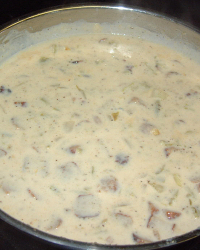
Okay, I am always up for a challenge so I set out to find a good recipe and I found one that uses a Crockpot, another bonus.  So here below is the recipe.  I made this last night and it came out pretty good, I need to tweak it a little but it was still good.  I served it with whole wheat spaghetti.

Chicken Paprikash
Serves 6
Cook time 5+ hours

Ingredients:
1 1/2 cup water
5 lbs chicken pieces (I used split chicken breasts)
1 cup canned tomatoes (I used a half jar of pasta sauce cuz it’s all I had)
1 green bell pepper, chopped
1 small onion, sliced
2 tablespoons sweet or hot paprika
1 clove garlic, minced
1/2 teaspoon oregano (I used 1/2 teaspoon of Italian Seasoning)
salt and pepper to taste
1/4 cup all-purpose flour
1 cup sour cream

Directions:

Put the water, chicken, tomatoes, green pepper, onion, paprika, garlic, salt, pepper, and oregano into the crock pot.  Stir to blend.  Cover the pot and cook on low for 9 or 10 hours until chicken is tender.

Remove chicken from the crockpot and skim fat from the remaining sauce.

Remove 1/4 cup liquid from the crock pot and allow to cool a bit.  Blend flour with the 1/4 cup cooled juices and return the flour mixture to the liquid in the crockpot.  Mix well and stir until thickened.

Blend in sour cream.  Return chicken to the pot and allow to heat through, but do not boil.  Serve on cooked noodles if desired.

Like I said, it came out pretty good.  I only cooked it for 5 hours in the crockpot and I assume the longer you cook it the better it will be.  Give it a try!

Met. Jonah: Encyclical on Marriage and the Moral Limits of Human Sexuality

July 28, 2011

Beloved Fathers, brothers and sisters in Christ,
If we say we have fellowship with him while we walk in darkness, we lie and do not practice the truth. But if we walk in the light, as he is in the light, we have fellowship with one another, and the blood of Jesus his Son cleanses us from all sin. If we say we have no sin, we deceive ourselves, and the truth is not in us. If we confess our sins, he is faithful and just to forgive us our sins and to cleanse us from all unrighteousness. If we say we have not sinned, we make him a liar, and his word is not in us. (1 John 1:6-10)
In our own lifetimes we were blessed by an act of prophetic witness in July 1992, when the Holy Synod of Bishops of the Orthodox Church in America issued the magnificent “Affirmations on Marriage, Family, Sexuality, and the Sanctity of Life.” Two decades later we Orthodox who live in the diocese that includes our nation’s capital city need to be reminded of some of the moral verities contained in the Affirmations. It should be obvious to any attentive observer that those verities are under increasing assault by the intellectual, social, and cultural elites in this country—and even by many of our public officials, particularly in the federal government headquartered here in Washington, DC. More alarming is the erosion of those moral verities within some of our Orthodox congregations.
The dire need to preserve and protect the sanctity of human life from the moment of conception has been the focus of the annual encyclical of the OCA primate for Sanctity of Life Sunday each January for many years. I wish to remind you, in the prophetic spirit of the apostles, that the Holy Mystery of Matrimony and the moral limits of human sexuality are ancient traditions of the Church not subject to whatever winds of change may be blowing through our society at the moment.
The 1992 Affirmations enunciated clearly and forcefully the following principles and guidelines among others:

  • God wills that men and women marry, becoming husbands and wives. He commands them to increase and multiply in the procreation of children, being joined into “one flesh” by His divine grace and love. He wills that human beings live within families (Genesis 1:27; 2:21-24; Orthodox Marriage Service).
  • The Lord went even further to declare that people who look at others in order to lust after them in their hearts have “committed adultery” (cf. Matthew 5:27-30).
  • Christ’s apostles repeat the teachings of their Master, likening the unique marriage between one man and one woman to the union between Christ and His Church which they experience as the Lord’s very body and His bride (Ephesians 5:21-33; 2 Corinthians 11:2).
  • Marriage and family life are to be defended and protected against every open and subtle attack and ridicule.
  • Sexual intercourse is to be protected as a sacred expression of love within the community of heterosexual monogamous marriage in which alone it can be that for which God has given it to human beings for their sanctification.
  • Homosexuality is to be approached as the result of humanity’s rebellion against God, and so against its own nature and well-being. It is not to be taken as a way of living and acting for men and women made in God’s image and likeness.
  • Men and women with homosexual feelings and emotions are to be treated with the understanding, acceptance, love, justice and mercy due to all human beings.
  • People with homosexual tendencies are to be helped to admit these feelings to themselves and to others who will not reject or harm them. They are to seek assistance in discovering the specific causes of their homosexual orientation, and to work toward overcoming its harmful effects in their lives.
  • Persons struggling with homosexuality who accept the Orthodox faith and strive to fulfill the Orthodox way of life may be communicants of the Church with everyone else who believes and struggles. Those instructed and counseled in Orthodox Christian doctrine and ascetical life who still want to justify their behavior may not participate in the Church’s sacramental mysteries, since to do so would not help, but harm them.

Our life in Christ is constituted by repentance. If we are to be faithful Christians, we must be constantly turning toward God, away from our sins and passions, realizing the seriousness of our sin in a spirit of repentance, and striving to change our lives. We cannot approach the Holy Mysteries without living a life of repentance, and examining our consciences and confessing our sins. When we have fallen, we repent, and try to stop our sinful behavior. Otherwise, we risk communing unto judgment and condemnation. This discipline of the Christian life leads to salvation, enlightenment and the healing of our souls. We must be faithful to that discipline of life, if we are to call ourselves Orthodox Christians.
In light of the above, what Orthodox Christian in good conscience would dare to approach the chalice containing the life-giving Holy Mysteries of the Body and Blood of Our Lord, while refusing to acknowledge, confess, and eradicate from his or her life sins against authentic Christian marriage, including fornication, homosexual activity, or adultery? Which sexually active couples co-habiting without the Orthodox sacrament of marriage can expect the Church to bless their unholy union and welcome them to the life- giving Holy Mysteries of the Body and Blood of Our Lord, unless they find separate accommodations and cease their fornication and get married in the Church?
We are all called as Christians to live a life of chastity, pleasing to the Lord, married or single. If we are Christians we are all called, whatever our attractions or past habits, to the same saving discipline that will heal our souls. Otherwise we are living in hypocrisy, a living death; just as when we judge others struggling with their sins. This has been delivered to us from the Apostles and Holy Fathers, and remains unchanged to this day. The Orthodox teaching on chastity and Christian marriage is a fundamental element in Christian life and discipline. We are called to conform our lives to the Church and its disciplines, not alter the teachings of the Church to fit either a cultural fad or our own passions. Where we stand against the prevailing cultural trends, we must stand fast, because we know that obedience to the Church’s teaching leads us to communion with God and eternal life; and disobedience leads to alienation from God, spiritual death.
As the Lord proclaims in the Gospel of St. Luke, “Every one to whom much is given, of him will much be required. . .” (Luke 12:48, RSV). We Orthodox Christians have been granted eternal life as a free, unmerited divine gift. Virtuous struggle against sexual temptations is hardly too much for the Lord to ask of us. The Lord honors the genuine intent of those who, with humility and repentance, so struggle, even as He judges those who, moved by a spirit of pride and defiance, persist in the spiritual delusion that unnatural or unholy sexual activity can be blessed. I have already instructed the clergy of our Archdiocese to honor their ordinations by acting in full accordance with our uncompromising Orthodox moral tradition. I expect all of us faithful to honor our baptism and unique calling as Christians.
These teachings are not onerous, but rather, part of the light yoke and easy burden of being a faithful follower of Jesus Christ.
With love in Christ,
+Jonah
Archbishop of Washington
Metropolitan of All America and Canada

h/t AOI Blog

error: Content is protected !!