
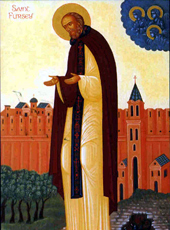
7 January ~ St. Fursey, Abbot of Lagny, near Paris

He was the son of Fintan, son of Finloga, prince of South Muster, and Gelgesia, daughter of Aedhfinn, prince of Hy-Briuin in Connaught. He was born probably amongst the Hy-Bruin, and was baptized by St. Brendan the Traveller, his father’s uncle, who then ruled a monastery in the Island of Oirbsen, now called Inisquin in Lough Corrib.
He was educated by St. Brendan’s monks, and when of proper age he embraced the religious life in the same monastery under the Abbot St. Meldan, his “soul-friend” (anam-chura). His great sanctity was early discerned, and there is a legend that here, through his prayers, twin children of a chieftain related to King Brendinus were raised from the dead. After some years he founded a monastery at Rathmat on the shore of Lough Corrib which Colgan identifies as Killursa, in the deanery of Annadown. Aspirants came in numbers to place themselves under his rule, but he wished to secure also some of his relatives for the new monastery. For this purpose he set out with some monks for Munster, but on coming near his father’s home he was seized with an apparently mortal illness. He fell into a trance from the ninth hour of the day to cock-crow, and while in this state was favoured with the first of the ecstatic visions which have rendered him famous in medieval literature.
In this vision were revealed to him the state of man in sin, the beauty of virtue. He heard the angelic choirs singing “the saints shall go from virtue to virtue, the God of Gods will appear in Sion”. An injunction was laid on him by the two angels who restored him to the body to become a more zealous labour in the harvest of the Lord. Again on the third night following, the ecstasy was renewed. He was rapt aloft by three angels who contended six times with demons for his soul. He saw the fires of hell, the strife of demons, and then heard the angel hosts sing in four choirs “Holy, holy, holy Lord God of hosts”. Among the spirits of the just made perfect he recognized Sts. Meldan and Beoan. They entertained him with much spiritual instruction concerning the duties of ecclesiastics and monks, the dreadful effects of pride and disobedience, the heinousness of spiritual and internal sins. They also predicted famine and pestilence. As he returned through the fire the demon hurled a tortured sinner at him, burning him, and the angel of the Lord said to him: “because thou didst receive the mantle of this man when dying in his sin the fire consuming him hath scarred thy body also.” The body of Fursey bore the mark ever after. His brothers Foillan and Ultan then joined the community at Rathmat, but Fursey seems to have renounced the administration of that monastery and to have devoted himself to preaching throughout the land, frequetly exorcising evil spirits. Exactly twelve months afterwards he was favoured with a third vision. The angel remained with him a whole day, instructed him for his preaching, and prescribed for him twelve years of apostolic labour. This he faithfully fulfilled in Ireland, and then stripping himself of all earthly goods he retired for a time to a small island in the ocean. Then he went with his brothers and other monks, bringing with him the relics of Sts. Meldan and Beoan, through Britain ( Wales) to East Anglia where he was honourably received by King Sigebert in 633. The latter gave him a tract of land at Cnobheresburg on which he built a monastery within the enclosure of a Roman fort–Burghcastle in Suffolk–surrounded by woods and overlooking the sea. Here he laboured for some years converting the Picts and Saxons. He also received King Sigebert into the religious state. Three miracles are recorded of his life in this monastery. Again he retired for one year to live with Ultan the life of an anchorite.
When war threatened East Anglia, Fursey, disbanding his monks until quieter times should come, sailed with his brothers and six other monks to Gaul. He arrived in Normandy in 648. Passing through Ponthieu, in a village near Mézerolles he found grief and lamendation on all sides, for the only son of Duke Hayson, the Lord of that country, lay dead. At the prayer of Fursey the boy was restored. Pursuing his journey to Neustria he cured many infirmities on the way, by miracles he converted a robber and his family, who attacked the monks in the wood near Corbie, and also the inhospitable worldling Ermelinda, who had refused to harbour the weary travellers. His fame preceded him to Péronne, where he was joyfully received by Erkinoald, and through his prayers obtained the reprive of six criminals. He was offered any site in the king’s dominions for a monastery. He selected Latiniacum (Lagny), close to Chelles and about six miles from Paris, a spot beside the Marne, covered with shady woods and abounding in fruitful vineyards. Here he built his monastery and three chapels, one dedicated to the Saviour, one to St. Peter, and the third, an unpretending structure, afterwards dedicated to St. Fursey himself. Many of his countrymen were attracted to his rule at Lagny, among them Emilian, Eloquius, Mombulus, Adalgisius, Etto, Bertuin, Fredegand, Lactan, Malguil. Having certain premonitions of his end, he set out to visit his brothers Foillan and Ultan who had by this time recruited the scattered monks of Cnobheresburg and re-established that monastery but his last illness struck him down in the very village in which his prayer had restored Duke Haymon’s son to life. The village was thence-forward called Forsheim, that is, the house of Fursey. In accordance with his own wish his remains were brought to Péronne, many prodigies attending their transmission, and deposited in the portico of the church of St. Peter to which he had consigned the relics of Sts. Meldan and Beoan. His body lay unburied there for thirty days pending the dedication of the church, visited by pilgrims from all parts, incorrupt and exhaling a sweet odour. It was then deposited near the altar. Four years later, on 9 February, the remains were translated with great solemnity by St. Eligius, Bishop of Noyon, and Cuthbert, Bishop of Cambrai, to a chapel specially built for them to the east of the altar. In the “Annals of the Four Masters”, Péronne is called Cathair Fursa.
In art St. Fursey is represented with two oxen at his feet in commemoration of the prodigy by which, according to legend, Erkinoald’s claim to his body was made good; or he is represented striking water from the soil at Lagny with the point of his staff; or beholding a vision of angels, or gazing at the flames of purgatory and hell. It is disputed whether he was a bishop; he may have been a chorepiscopus. A litany attributed to him is among the manuscripts in Trinity College Dublin.

Source

7 January ~ Cedd of Lastingham, Bishop of the East Saxons

St. Cedd was the eldest of four holy brothers, born into a noble Northumbrian family at the beginning of the 7th century. With his siblings, Cynebil, Caelin & (St.) Chad, he entered the school at Lindisfarne Priory at an early age and learnt the ways of the Irish monks under Bishop Aidan. They were eventually sent to Ireland for further study and all four subsequently became priests…
In AD 653, the mighty armies of King Penda of Mercia expanded their monarch’s influence to the control of Middle Anglia (Leicestershire and parts of Lincoln and Derby), where his son Peada was appointed King. Soon afterward, the young king visited his neighbour, King Oswiu of Northumbria, at Walton (or Atwell or Wattbottle) and, as his new kingdom had already been considerably influenced by East Anglian Christianity, Peada agreed to be baptised in return for the hand of Oswiu’s daughter, Alchflaed. Bishop Finan of Lindisfarne therefore welcomed the King and a number of his nobles into the Christian faith and Oswiu provided him with four priests to instruct his people further. One of these was St. Cedd.
Within a year, Cedd returned home, having helped to convert much of Middle Anglia to Christianity. He travelled to Lindisfarne to confer with Bishop Finan, who promptly sent this impress young missionary out once more to evangelise the people of Essex, who were sorely in need of some spiritual guidance. King Oswiu, having imposed his overlordship there, had persuaded King Sigeberht Sanctus to adopt Christianity, in a general mobilization against Penda of Mercia. Cedd thus turned south again to spread the word of God amongst the East Saxons. He baptised many of the locals and built several churches – possibly Prittlewell and West Mersea amongst them – and is particularly noted for the foundation of monasteries at Ythanchester (Bradwell-on-Sea) and Tilaburg (East Tilbury).
The following year, Cedd made a brief visit to Northumbria once more, where Bishop Finan had no hesitation in ordaining him as Bishop of Essex. Back in his southern province, Cedd pursued the work he had previously begun with more ample authority. He re-instated St. Paul’s in London as the main seat of his diocese. He ordained priests and deacons to assist him in his work and gathered together a large flock of servants of Christ in his two monastic foundations.
Bishop Cedd always remained fond of his homeland, however, and was wont to make regular visits there. On one such occasion in AD 658, Cedd was approached by King Aethelwald of Deira who had been instructed in Christianity and administered the Sacraments by the Bishop’s brother, Caelin. Finding Cedd to be a good and wise man, he pressed upon him to accept a parcel of land at Laestingaeu (Lastingham in Yorkshire) on which to build a Royal monastery and prospective mausoleum. Cedd eventually agreed, but would not lay the foundation stones until the place had first been cleansed through prayer and fasting. This, he undertook himself throughout lent, until his brother, Cynebil, took over, when the Bishop was called to the Royal Court. Cedd was the first Abbot of Lastingham and remained so while still administering to his flock in Essex.
Christianity had not quite been universally accepted in Cedd’s southern province and, by AD 660, there was considerable discontent with the rule of King Sigeberht of Essex. He was murdered by his brothers, Swithelm and Swithfrith, and the former took the throne as a pagan King. St. Cedd was forced to flee north into East Anglia, where he settled at the Court of King Aethelwald at Rendlesham (Suffolk). The East Anglians appear to have held some sort of overlordship in Essex at this time and, within about two years, Aethelwald had persuaded Swithelm that it would be in his interest to become Christian. Cedd baptised him at Rendlesham, with Aethelwald as his godfather, and the two returned to Essex.
It was around this time that, owing to the influence of St. Wilfrid who had been established at Ripon by King Alchfrith of Deira, that a great divide was forming in the Northumbrian Church. All the missionaries of the north had been brought up in Iona or Lindisfarne, and followed the Celtic ritual. Wilfrid, ordained by a French bishop, introduced Roman ways. The split even extended to the Royal household where, each year, Oswiu celebrated the Celtic Easter feast and his Queen, the Roman. To settle this difference, and prevent a rupture, the King convened a religious synod at Whitby in AD 664. St. Cedd attended the synod – probably with his brother, Chad – to act as interpreter and to speak on behalf of his fellow Celtic ecclesiastics, Bishop Colman of Lindisfarne and Abbess Hilda of Whitby. On the opposing side were Abbot Wilfrid of Ripon, former Bishop Agilbert of Wessex, Romanus, the Queen’s chaplain, and James the Deacon who had remained in Swaledale after St. Paulinus had fled Yorkshire. After much debate, it was decided that the Roman usages should be adopted and Cedd, along with many others, reluctantly renounced the customs of Lindisfarne and returned to his diocese to spread the new Roman ways amongst the people of Essex.
The same year, Cedd visited his Abbey at Lastingham while a great plague was, unfortunately, raging through the area. Both he and his brother, Cynebil, fell sick and, after placing Lastingham in the charge of their youngest brother, Chad, they died. Cedd was first buried in the open air and his funeral was attended by some thirty monks from Bradwell who, sadly, also contracted the plague and died. Eventually, a little stone church was built at the Lastingham, in honour the Virgin Mary, and Cedd’s body was interred there, to the right of the altar. The latter remains intact in the Norman crypt that was later built on the site, though St. Cedd’s bones were removed around the same time to the cathedral founded by his brother, Chad, at Lichfield.

Source

Church Leadership

When one thinks of the Orthodox Church one thinks of many things, worship, theology, etc. the term leadership is not one that springs to mind right away. Oh sure we have our share and have had our share of leaders but what I am speaking of is leadership of the Church in the 21st century. Yesterday I wrote about Engaged Monasticism and how we need a different model of monasticism in 21st America, well we also need leaders of for the 21st Century.
During my seminary preparation there were no courses designed to teach leadership skills. I do not always buy into the saying that “leaders are born” I think leaders can be created and taught and mentored by other leaders. Flipping through the seminary catalogue today reveals only one leadership course, it’s called Parish Administration and it is a survey course taught once a week.
How do we lead churches with a diverse population? I have parishioners that span 4 generations from depression era, boomers, X, Y, millennials etc. they are all present in my parish. You do not lead all of those groups the same way. Good leaders inspire those they lead to do what needs to be done. Good leaders inspire those they lead to think outside the box. I have not always done this and it is something I hope to work on this year.
Good leaders are good readers and a good leader is also someone who is not afraid to change tact when needed. I grew up learning how to sail. When you sail you need to be conscious of the wind and change directions as the wind blows. Now I am not saying the church needs to change her theology or practice, no I am suggesting we need to change the way we present it.
Good leaders are good readers. I read a lot. I read a variety of things, some are from books and others are from blogs I have found useful on the web. There is a tremendous amount of information out there if you know where to look. Today I came across a list of “20 Blogs Every Church Leader Should be Reading” on the website Church Leaders. I was not surprised that on that list no Orthodox Leaders were present. I was surprised not to see the blog of Deacon Michael Hyatt but alas it was not there.
They are all Evangelical blogs written by pastors or other church leaders. No I know what you die hard Orthodox will say? What can we learn from them? I say to you get over yourself! If we were doing all we can do to lead our congregations we would be a force to be reckoned with. We “have found the true faith” we just don’t know how to tell people about it.
So what am I going to do? I have selected a few blogs from the list I quoted above and over the next year I will be posting links and excerpts from those blogs and putting into practice the lessons and letting you know how it has worked. I am not afraid to change what I am doing and I hope you are not as well. Let’s see if we can get an Orthodox Leadership Blog on that list next year.

Engaged Monasticism

I have been writing about monastic topics for the last few years. I have been trying to develop a sense of what I have called the “new monasticism” although it is not really all that new. I say it is not all that new but in the modern Orthodox Church, especially the Orthodox Church in North America this is a new concept.
In 369 AD St. Basil the great was a newly ordained priest ministering in and around the area of Constantinople. That year a drought hit followed by famine as the crops had all dried up. He delivered four homilies that have been complied in the book “On Social Justice” that spoke to the heart of how people act in these times of dire physical suffering. Many of the themes from these homilies are repeating themselves today as they have throughout history.
St. Basil had a vision of a new social order based upon simplicity of life and sharing rather than competition and private ownership. He had a vision for what would be called “the new city.”
Part of this new city would be an engaged monasticism, a monastic vision that was more urban than rural, a monasticism, which has at its very heart, service to the poor. He had a vision for what would be called the Basiliad, a complex of buildings where the poor and needy would come and find support and rest. Medical care would be provided by skilled physicians and food and clothing would be provided. But it was also to be a worship center with church services and a chapel. A place to truly live out the gospel message of “love of neighbor.”
The monks would practice the practical trades like carpentry and blacksmithing and the money generated from those trades would be used to support the work of the Basiliad. In his sermon, In Time of Famine and Drought” he speaks of this new community not as a new kind of charitable institution but a place where a new set of relationships would be formed. A new social order that would both anticipate and participate in the creation of “a new heaven and a new earth where justice dwells.” St. Basil used his vision of the first church at Jerusalem as an example, “Let us zealously imitate the early Christian community, where everything was held in common – life, soul, concord, a common table, individual kinship – while unfeigned love constituted many bodies as one and joined by many souls into a single harmonious whole.”
Fast forward to the 20th century and we find the writings of St. Mother Maria of Paris. I don’t think there is a saint that has influenced my thoughts on monasticism more than she has. Mother Maria saw the need for monasticism in the Orthodox Church, and as I have often said the church is at her best when monasticism is present in the Church, but as we have had to adapt the church to the new world monasticism needs to be adapted to the new world. Mother Maria, and I for that matter, does not believe that traditional monasticism can work in America, well not all aspects of it anyway.
Mother Maria wrote an essay that she called “Toward a New Monasticism” it was written at a time where refugees had swarmed into Paris during the Second World War. She had a house that she called the “Open Door” where she ministered to the refugees mostly on her own. In this essay she has this to say about monasticism and her view of a new monasticism:
“…monasticism in general is needed, but it is needed mainly on the roads of life, in the very thick of it. Today there is only one monastery for a monk – the whole world. This he must inevitably understand very soon, and in this lies the force of his innovation. Here many must become innovators against their will. This is the meaning, the cause, and the justification of the new monasticism. The new here is not characterized mainly by its newness, but by its being inevitable. There is no need to seek in these statements for any non-recognition of the old form of monasticism on principle. But, needed as it is, it does not exhaust what the churchly word now has the right to expect from monasticism. It may be only a part… of contemporary monasticism.”
We have other examples of the “New Monasticism” the most notable is St. Herman of Alaska. St. Herman came to the new world to minister not only to the Russians in Alaska but also to the native population. He was a monastic and came with other monastics, but did not live what one thinks of as a traditional monastic life.
We also have examples of engaged monasticism in the Church in North American now. St. Tikhon in South Canaan, Pennsylvania runs a seminary and prepares men for service in the church, they are engaged in the process and what is needed is more of this type of work.
What I am suggesting is not radical but a return to a vision of monasticism put forth in the 4th century by St. Basil. My belief is this is the style of monasticism that is needed in North America, we need balance in monasticism and this is an area that is lacking.

2011 ~ A Blog Year in Review

So I thought I would take a little look to see how the blog did this past year.  I guess its vanity but I do like to see where you are coming from and what you are interested in so I know what to write about.  It has been a pleasure to bring you thoughts and reflections this past year and I look forward to 2012.  Thanks for visiting in 2011.  These numbers come from Google Analytics.

13,567 People visited this blog in 2011
26, 476 Pages were viewed in 2011

4,355 were directed to this site from http://www.reddit.com/

64.88% were new visitors
35.11% were returning (I need to do a better job getting you to come back!)

91.26% of you speak English

Where are you from?
United States  81.07%
Canada  3.97%
UK 3.17%
Australia  1.23%

Top Posts for 2011

The top 2 were the main page and the About Me Page so I will not list those

Roman Catholic Orthodox Differences on Original Sin
Parastas (Paos) Service
Restless Night
Soup
Mystery Solved
Southbridge Tornado Update
How to Destroy a Culture in 5 Easy Steps
Orthodox Prayer Against Bad Weather
Easter Eggs not Spring Spheres
Tornado on the Ground

St. Basil the Great ~ On Social Justice

“The bread which you do not use is the bread of the hungry; the garment hanging in your wardrobe is the garment of him who is naked; the shoes that you do not wear are the shoes of the one who is barefoot; the money that you keep locked away is the money of the poor; the acts of charity that you do not perform are so many injustices that you commit.”

The Blessings of the New Year

God, bless to me the new day,

Never vouchsafed to me before;
It is to bless Thine own presence
Thou hast given me this time, O God.

Bless Thou to me mine eye,
May mine eye bless all it sees;
I will bless my neighbor,
May my neighbor bless me.
God, give me a clean heart,
Let me not from sight of Thine eye;
Bless to me my children and my wife,
And bless to me my means and my cattle.

Carmichael, Alexander; Carmina Gadelica, Hymns and Incantations

Leavetaking of the Nativity

We like feasts in the Orthodox Church. We have the Prefeast, the Feast itself, the Leavetaking, and then the afterfeast. We have one of those today.
Six days after the Nativity is the Leavetaking or the Apodosis (conclusion) of the Nativity of our Lord and Savior Jesus Christ in the Flesh. On this day we repeat the liturgical rubrics of the feast itself.
Some feasts have longer afterfeasts and some actually have none. Pascha for example lasts 38 days, that leaves room for the Prefeast of Pentecost. I know it is all very confusing.
So today be bid farewell to the feast of the Nativity and prepare for the Feast of Theophany. However, the Christmas season does not end until January 6th so keep that tree in place!
Your Nativity, O Christ our God, Has shone to the world the Light of wisdom! For by it, those who worshipped the stars, Were taught by a Star to adore You, The Sun of Righteousness, And to know You, the Orient from on High. O Lord, glory to You! (Troparion of the Nativity)

Today the Virgin gives birth to the Transcendent One, And the earth offers a cave to the Unapproachable One! Angels with shepherds glorify Him! The wise men journey with a star! Since for our sake the Eternal God was born as a Little Child! (Kontakion of the Nativity)

Saying Goodbye

I had the honor recently of participating in the funeral of a very dear friend. Jim was our neighbor my entire life and a great family friend. When we were kids life was much different than it is now. The neighbors would look out for you and if you did anything wrong, they would call your parents who would thank them for calling. Things really have changed.
The last few years, since both Jim and my dad retired, they would meet each morning for coffee and then each afternoon for “tea” (that’s code for a drink of Scotch). They would talk about all sorts of things from cutting the grass to local and national politics. When I was able to get home I would join them for these conversations. It was always an experience.
Jim had been sick the last year but still kept up with the daily ritual until he was too sick. He passed just before Christmas and we said goodbye at the funeral. One of the tasks of the priest is to say goodbye. In the Orthodox tradition the funeral is conducted with the casket open and at the end of the funeral service all those in attendance come up and say their last goodbye. The final blessing is given and the casket is closed. There is something comforting about doing that.
As we approach the end of the year it is time to say goodbye to the old year and hello to the new. A time to look back on all that was accomplished and what was not. It is a time for nostalgia to take over and maybe we get a little sad that the year is coming to a close. I for one will not be sad to see 2011 come to an end. It was a very difficult year for so many and I look forward to what the New Year will bring for all of us.
On New Year’s Eve, many of us will sing the great song Auld Lang Syne. Maybe we will join hands as is the custom in the Scottish Community, or maybe we will just sing the words. The song has many meanings for many people but for me it is about holding on to the good memories and forgetting the bad. Remembering friends and family and the love we have for each other and moving on past the bad. We cannot change the past all we can do is to make the future better. I believe that everything happens for a reason and it’s not what happens but what we learn from it.
I pray that 2012 is a great year for all of us.
Auld Lang Syne (In the Original Scots)
CHORUS
Shid ald akwentans bee firgot,
an nivir brocht ti mynd?
Shid ald akwentans bee firgot,
an ald lang syn*?
CHORUS:
Fir ald lang syn, ma jo (or ma dear),
fir ald lang syn,
wil tak a cup o kyndnes yet,
fir ald lang syn.
An sheerly yil bee yur pynt-staup!
an sheerly al bee myn!
An will tak a cup o kyndnes yet,
fir ald lang syn.
CHORUS
We twa hay rin aboot the braes,
an pood the gowans fyn;
Bit weev wandert monae a weery fet,
sin ald lang syn.
CHORUS
We twa hay pedilt in the burn,
fray mornin sun til dyn;
But seas between us bred hay roard
sin ald lang syn.
CHORUS
An thers a han, my trustee feer!
an gees a han o thyn!
And we’ll tak a richt‡ gude-willie-waucht‡,
fir ald lang syn.
CHORUS

5th Day of Christmas ~ Holy Innocents

Holy Innocents
On the 5th day of Christmas the Church remembers the 14,000 Holy Innocents murdered by Herod after the birth of Jesus.
The story is recounted in the Gospel of St. Matthew Chapter 2 verses 13-23. After the birth of Jesus the Magi come from the East. The go and see Herod who tells them to come back and let him know where the Child was born so that he could go and worship him. Herod saw Jesus as a threat to his reign as King and wanted to snuff him out.
After their visit with the Holy Family, the Magi left another way to go home. Herod got mad and ordered that all male children under the age of 2 be murder. Since he was not sure where Jesus was he figured this would get him one way or another. However Joseph had already taken Jesus and Mary to Egypt to avoid this killing.
The Church considered these 14,000 children to be the first Christian Martyrs and on this 5th day after the Nativity commemorates them.
How many Holy Innocents have been murdered since this date? How many innocent children have been abused, neglected, or abandoned? On this day of the Holy Innocents let us pray that God will protect all of the innocents in the world.
When the King was born in Bethlehem, the Magi came from the East. Having been led by a star from on High, they brought Him gifts. But in exceeding wrath, Herod harvested the infants as sorrowing wheat; the rule of his kingdom has come to an end. (Kontakion of the Holy Innocents)
error: Content is protected !!